

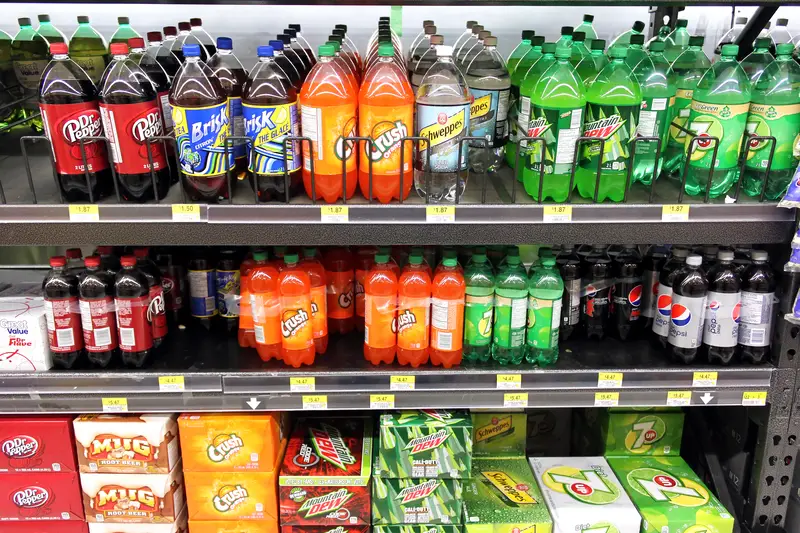
Every year, food writers and health experts put out their definitive soda rankings. They taste-test dozens of brands, crunch the nutritional numbers, and argue about which fizzy drinks deserve your money. And every year, one soda keeps showing up at the absolute bottom. It doesn’t matter if the ranking is based on taste, sugar content, or general consumer opinion — this drink cannot catch a break. If you’ve spent any time in a gas station at 2 a.m., you probably already know which one I’m talking about.
Let’s run through the worst of the worst, starting at the very bottom and working our way up to sodas that are still bad but at least have something going for them.
Mountain Dew
There it is. The radioactive-looking lime-green soda that keeps landing in last place across multiple comprehensive rankings. Mountain Dew’s problems start before you even open the can. That neon color looks like it belongs in a beaker, not a cup. Back in the 1960s, it might have been cool to dye your drinks the color of antifreeze, but in 2024 it just looks wrong.
But appearance is just the beginning. A single 12-ounce can of Mountain Dew packs 46 grams of sugar — about 11 teaspoons. That’s 92% of the daily recommended sugar intake gone in one drink. A 20-ounce bottle? Seventy-seven grams. And here’s a fun detail that should make you put the bottle down: Mountain Dew contains brominated vegetable oil, which is literally a patented flame retardant for plastics. It’s been banned in food products across Europe and Japan. About 10% of sodas sold in the U.S. still contain BVO, and Mountain Dew is one of the most well-known offenders. It also has more caffeine than most people realize, which combined with all that sugar creates an energy spike and crash that gamers and college students know all too well.
Mountain Dew sells like crazy — it’s one of the top-selling soda brands in America. But popularity and quality are two different things, and when experts actually sit down to evaluate what’s in your can, the Dew lands where it always does: dead last.
Nitro Pepsi Draft Cola
If Mountain Dew is the worst-tasting soda, Nitro Pepsi is the worst soda for your body. This nitrogen-infused cola sounds like something a marketing team dreamed up during a monster truck rally, and the nutritional facts are just as aggressive. One 13.65-ounce can contains 62 grams of sugar — that’s 124% of the FDA’s daily added sugar limit. If you follow the American Heart Association’s stricter recommendation of 25 grams for women, you’re looking at nearly 250% of your daily limit in a single can.
To put that in terms that actually mean something: drinking one Nitro Pepsi is the sugar equivalent of eating six Original Glazed Krispy Kreme donuts. Fifteen teaspoons of sugar crammed into one container. The Center for Science in the Public Interest confirmed that Nitro Pepsi has about 32% more sugar per ounce than regular Pepsi because the larger can size allowed PepsiCo to concentrate even more high-fructose corn syrup into the formula. You’d need about 38 minutes of fast walking just to burn off the calories from one can. The creamy nitrogen gimmick doesn’t come close to justifying any of this.
Fanta Grape
A Denver-based personal trainer broke down the ingredients in 70 popular sodas and put Fanta Grape at the very bottom. At 180 calories and 48 grams of sugar per 12-ounce can, it’s essentially a liquefied bag of Skittles — and you’d actually need to add six more grams of sugar to the Skittles to match the sweetness. The ingredient list reads like a chemistry set: high-fructose corn syrup, tartaric acid, Red 40, Blue 1, sodium benzoate. Canadian researchers found that Red 40 was contaminated with known carcinogens.
Fanta also carries a weird historical footnote. Coca-Cola created the brand to keep making money in Germany during World War II when Nazi trade restrictions blocked the importation of American-made Coke. The soda has obviously evolved since then, but even stripped of its unsettling origin story, the modern version is still one of the worst things you can pour into your body.
Sun Drop
Sun Drop tries to position itself as an alternative to mainstream citrus sodas, and that’s a nice way of saying it’s Mountain Dew’s less popular cousin who nobody invited to the party. A 20-ounce bottle contains 75 grams of sugar and 290 calories. That’s the same amount of sugar you’d get from eating three full-sized Hershey’s Milk Chocolate Bars. In a 12-ounce can, you’re still getting 45 grams of sugar and the third-highest caffeine content among sodas at 64 mg — about 1.6 times higher than most caffeinated drinks.
The taste doesn’t help its case either. The citrus flavor comes across as muted and undefined, lacking the sharpness that makes a citrus soda worth drinking. Somehow it manages to be even more cloying and syrupy than Mountain Dew, which is saying something. The weak citrus taste combined with the overwhelming sweetness makes the whole thing taste unbalanced — like someone poured simple syrup into a glass and then waved a lemon over it from across the room.
Surge
Surge came back in the mid-2010s after disappearing from shelves, banking on the nostalgia of 90s kids who remembered it fondly. The problem is that childhood memories are liars. What tasted exciting to a 10-year-old tastes incredibly artificial and overwhelming to adult palates. The citrus flavor doesn’t remotely resemble actual fruit — it’s more like a chemical approximation of what a lab technician thinks citrus should taste like.
At nearly 240 calories per can, Surge packs an enormous sugar payload into a drink that’s basically a time capsule from an era when artificial ingredients were considered a selling point. It has nostalgic appeal, sure, but nostalgia doesn’t change what’s on the nutrition label. If you want to relive the 90s, go rewatch TRL. Don’t drink this.
Diet Mountain Dew
You’d think the diet version would fix at least some of Mountain Dew’s problems. It doesn’t. It somehow makes them worse. The same unsettling yellowish-green color remains, but now it’s paired with an even more disappointing experience. Pour it into a glass and you’ll notice it gives off virtually no aroma. When something claims to be citrus-flavored but smells like absolutely nothing, you should already be suspicious.
Take a sip and you get vague orange and lime notes that fade immediately, leaving you wondering why you bothered. The artificial sweeteners create a chemical-like aftertaste that’s even worse than the original’s sugar overload. Diet Mountain Dew is the rare product that fails from every direction — it’s not refreshing, it’s not satisfying, and whatever you were hoping to avoid by choosing the diet version gets replaced by something equally unpleasant.
Mountain Dew Frost Bite
This one is almost impressive in how badly it misses. Mountain Dew Frost Bite has a bold blue color and “cool melon” marketing that sets up expectations of something exciting. What you actually get is basically carbonated water with blue food coloring. There’s no distinct taste. None. People expect something like a blue movie theater slushie and instead get a drink so flavorless they can’t even describe what’s wrong with it.
The cruel irony is that Frost Bite isn’t bad enough to be memorably terrible. It just sits there, existing, tasting like nothing, wasting your time and your $2. At least the other Mountain Dew variants commit to being aggressively sugary or offensively artificial. Frost Bite can’t even manage that.
Mug Root Beer
Mug is technically a Pepsi brand, but it doesn’t have much in common with anything PepsiCo should be proud of. The main complaint is simple: it’s watery. Root beer lives and dies by its richness, and Mug has none. It doesn’t have the bite of Barq’s or the creamy taste of A&W. What it has is a muted, less impressive version of everything that makes those root beers actually enjoyable.
Nobody is going to pick Mug Root Beer when literally any other root beer exists in the same cooler. It’s the soda equivalent of showing up to a party and standing in the corner saying nothing. Not offensive, just pointless.
Diet Coke
Here’s one that might surprise you. When Best Life analyzed consumer data across annual revenue, fan polls, and social media engagement, Diet Coke came out as the least popular soda in America among major brands. Not the worst-tasting or the unhealthiest — just the one that, statistically, the fewest people actually like. Sierra Mist, Sunkist, 7-Up, and Barq’s Root Beer rounded out the bottom five.
Diet Coke has its devoted fans (you know who you are), but the broader consumer data tells a different story. In a market projected to hit $388.4 billion by 2025, being the brand that brings up the rear is not where you want to be.
The Pattern Is Obvious
Whether the ranking is about taste, health, or popularity, the same names keep appearing at the bottom. Mountain Dew and its many variants dominate the worst-of lists like no other brand. Americans still drink about 480 cans of soda per person each year — nearly 40 gallons — even though consumption has dropped significantly over the past two decades. In 1999, the average American was putting away almost 50 gallons per year. That number has come down, but we’re still drinking a lot of this stuff.
The sodas that keep ranking last all share the same problems: absurd sugar content, artificial dyes that look more at home in a paint aisle, and flavors that either taste like chemicals or taste like nothing at all. Mountain Dew checks every single one of those boxes, which is why it keeps ending up right where it belongs — at the very bottom of the list.
