

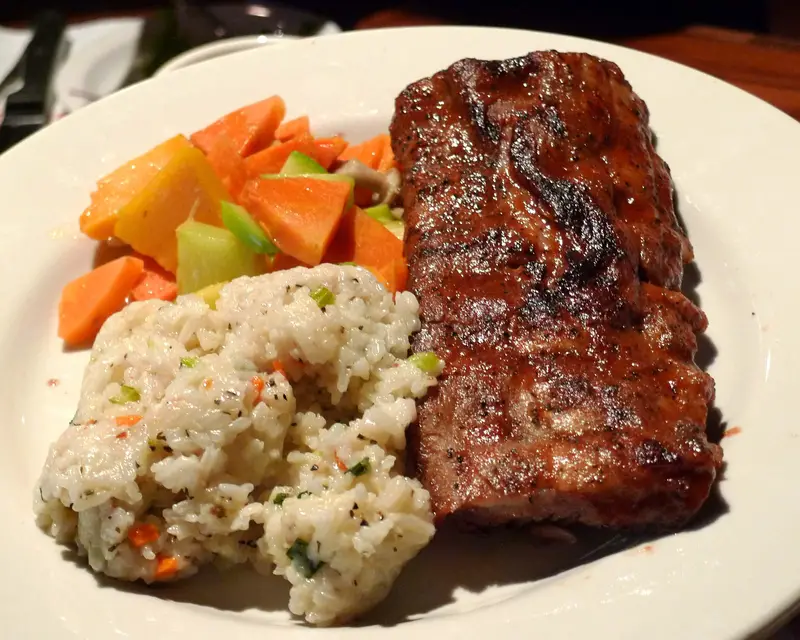
There’s a certain kind of disappointment that only a bad steak dinner can deliver. You get dressed up, drive across town, sit down at a dimly lit table, and mentally prepare yourself to spend real money. Then the steak arrives, and it’s… fine. Just fine. Not memorable, not special, not even close to what you could’ve done with a cast iron skillet at home. And the bill? Somewhere between insulting and criminal.
That feeling is exactly what keeps popping up in reviews for Outback Steakhouse — the chain that somehow became one of the most recognizable names in American dining while quietly becoming one of the least deserving of your money. But Outback isn’t alone in the overhyped steakhouse world. A bunch of chains are charging more, delivering less, and banking on brand recognition instead of, you know, good steak.
Outback Steakhouse Has a Serious Identity Crisis
Let’s start with the elephant in the room. Outback Steakhouse has over 650 locations in the U.S., and for a long time, it was the go-to casual steakhouse for millions of families. But something changed. During COVID, Outback raised its prices while shrinking its portions — a classic cost-cutting move that customers noticed immediately. A 13-ounce ribeye runs $27.99 at Outback. A similar steak at LongHorn? $26.49. At Texas Roadhouse? You’ll pay $25.49 for a 14-ounce cut — a bigger steak for less money.
The numbers tell the story. While LongHorn’s parent company Darden saw total sales grow by 8.6% in fiscal year 2024, Outback’s parent company Bloomin’ Brands was dealing with declining sales, falling stock, and closing more than 40 restaurants. In September 2024, Bloomin’ Brands brought in a new CEO, Michael Spanos — a guy with zero restaurant industry experience. In a 2025 earnings call, Spanos admitted, “We are not where we want to be, especially in comparison to other steakhouse chains.” That’s a remarkable thing for a CEO to say out loud.
Part of the problem is quality. A former server and restaurant manager explained on Quora that Outback uses USDA Choice beef, while premium steakhouses use USDA Prime. Prime gets that rating because of the fat marbling — the stuff that makes a steak juicy and tender. That could explain why so many diners have complained about tough, dry steaks. When Mashed polled readers on which chain had the worst steak, Outback got the most votes.
The company has announced a $75 million investment from 2026 through 2028 aimed at better steak quality and preparation. But right now? You’re paying more for less, and the Bloomin’ Onion can only carry so much weight.
STK Is the Steakhouse That Forgot About the Steak
STK is one of those places that feels like it was designed by someone who Googled “cool restaurant” and ran with it. Every location has an in-house DJ. The lighting is moody. The vibe screams nightclub. The problem? This is supposed to be a steakhouse, and the actual steak part keeps getting lost in the noise.
STK’s Charlotte, North Carolina location sits at a miserable 2.7 out of 5 stars on TripAdvisor. Customers have called it overpriced and overhyped, encouraging others to save their money or eat elsewhere. The online menu doesn’t even list prices — which is never a good sign. Reviewers report meals costing between $70 and $150 per person, with one saying if you want to have a good time, plan on at least $150 a head.
London diners have called it too loud and tacky. Multiple Reddit users have said they’ve had better steak at Texas Roadhouse. When a chain that charges triple the price keeps getting compared unfavorably to a restaurant with peanut shells on the floor, something has gone seriously wrong. The steaks have been called “just OK” and “not very seasoned” — not exactly the words you want attached to a $90 entrée.
Ruth’s Chris: Still Riding the Reputation
Ruth’s Chris Steak House has been around since 1927 and now has 154 locations worldwide. It’s owned by Darden Restaurants, headquartered in Winter Park, Florida, and it’s been a heavyweight in the high-end steakhouse world for decades. But decades of reputation can also breed complacency.
Their steaks range from $60 to $81, with a porterhouse for two at $123 and a 40-ounce tomahawk ribeye at $149. And those prices don’t include sides — potatoes, vegetables, even the butter they put on your steak all cost extra. A Quora commenter reported that a meal with beverages runs from $60 to $150 per person. One Reddit thread described a disappointing meal that cost $400, with multiple commenters saying they’ve had much better steaks at Texas Roadhouse — for a fraction of the price.
On TrustPilot, variations of “disappointing” appear constantly. “Overrated” shows up on Yelp. Those sizzling butter plates are dramatic, sure, but drama doesn’t make a steak worth a hundred bucks. There are plenty of diners who feel like they’re paying for the name on the building, not what’s on the plate.
Morton’s and Fleming’s: Same Problem, Different Tablecloths
Morton’s The Steakhouse has slightly lower prices than some competitors — steaks run from $44 to $69, and even their surf and turf is $69. A meal without alcohol can be had for $50 to $60 per person. But one Yelp diner in Rochester reported that a full meal for three with cocktails, wine, and appetizers came to $525. The word “overrated” appears in their reviews like a recurring bad dream.
One Yelper who actually liked the food still only gave Morton’s three stars, citing what they called an “old wealthy male club white collar feel.” A Reddit commenter summed it up well: high-end steakhouse steaks are delicious but “definitely not two to three times better than the regular chains.” Another Reddit user paid $150 for a NY strip and expected a decent char. There wasn’t any.
Fleming’s is in a similar boat. Despite serving USDA Prime cuts and winning multiple awards from Wine Spectator for its wine program, the food keeps leaving people cold. One Reddit user described the La Jolla, California location as “underwhelming.” Another complained about an overcooked steak and bland mashed potatoes. When your wine list gets more praise than your meat, you might have a steakhouse problem.
Del Frisco’s Isn’t What It Used to Be
Del Frisco’s has a specific problem: it got bought. Multiple reviews claim the restaurant “isn’t as good as it used to be,” and a former employee pointed the finger at the acquisition by Landry’s and billionaire Tilman Fertitta, who also owns Mastro’s, The Palm, and Saltgrass Steakhouse. That’s a lot of steakhouse brands under one roof, and apparently the consolidation hasn’t done Del Frisco’s any favors.
A three-star Yelp review from 2024 said the only enjoyable parts of the meal were the service and the bread. When bread is the highlight of your steakhouse dinner, you’ve got a serious issue. It’s a story you see over and over in the restaurant industry — a beloved brand gets acquired, corners get cut, and loyal customers slowly drift away.
The Budget Chains That Are Even Worse
If the expensive chains are disappointing, the budget ones can be downright grim. Sirloin Stockade, which operates across Texas, Oklahoma, Kentucky, and Missouri, gets reviews that read like horror stories. One Yelp reviewer in Ardmore, Oklahoma described a steak as “tasting rotted.” A Google reviewer said it’s “time to close this horrible place,” noting a steak “the size of a baby shoe and just as tough.” Cottage cheese on the salad bar was spoiled. Rolls were hard on the bottom as if they’d been sitting for days.
Western Sizzlin is another rough spot. One reviewer in Rocky Mount, North Carolina found their steak visually repulsive and watery, then noticed flies in the dessert station. When they showed a photo to an employee, the response was: “That’s why I don’t eat here.” That’s an actual quote from someone who works there.
Logan’s Roadhouse doesn’t fare much better. A customer in Huntsville, Alabama described their sirloin as reminding them of dog food. Multiple customers have reported steaks arriving undercooked or overcooked — sometimes both at the same table.
Where to Actually Spend Your Steak Money
So where should you go? The consistent winners in customer reviews are the chains that don’t pretend to be something they’re not. Texas Roadhouse keeps coming up as the benchmark — the restaurant that expensive chains keep getting compared to, unfavorably. LongHorn Steakhouse is another strong pick. Their grill masters train for weeks before working the line, and most entrées come with two sides included — a concept that shouldn’t feel radical but somehow does when you’ve been paying $14 for a baked potato somewhere else.
LongHorn also runs early bird specials before 6 PM with prime cuts at reduced prices. Their portions are big enough that you’re taking half home for lunch the next day. That’s two meals for less than one plate at Ruth’s Chris.
The Capital Grille is the one high-end chain that seems to consistently justify its prices. All their steaks are dry-aged on-site for at least 18 days and hand-cut by in-house butchers. One TripAdvisor reviewer called it “a bit on the expensive side but for the class of the establishment and the quality of the food, this is value for money.” With 66 locations in the U.S., it’s not hard to find one.
The lesson here isn’t that all steakhouse chains are bad. It’s that a big name and a fancy menu don’t guarantee a good steak. Sometimes the best move is the simplest one: find a place that takes the meat seriously, charges a fair price, and doesn’t need a DJ to distract you from what’s on your plate.
