

You’re standing in the soup aisle, maybe a little hungry, definitely a little tired, and you grab a can of something that looks warm and comforting. Chicken noodle. Tomato bisque. Maybe a clam chowder because it’s cold outside and you deserve it. You toss it in your cart without a second glance at the label. Big mistake.
Canned soup has been a kitchen staple in American homes for over a century. It’s cheap, it lasts forever, and it takes about four minutes to make. But that convenience comes at a cost — and I’m not talking about the $2.49 price tag. The ingredient labels on most canned soups read like a chemistry textbook, and some of the stuff hiding in those cans is genuinely alarming once you know what to look for.
Here’s what should make you put a can right back on the shelf.
Sodium Levels That Blow Past Your Entire Daily Limit
Everyone kind of knows canned soup is salty. But knowing it in the abstract and seeing the actual numbers are two very different experiences. Snow’s New England Style Clam Chowder packs 3,020 milligrams of sodium in a single can. The American Heart Association says you should stay under 2,300 milligrams for the whole day — ideally closer to 1,500. So one can of chowder blows right past your full daily ceiling before you’ve even had breakfast or dinner.
Campbell’s Cream of Chicken hits 2,175 milligrams per can. Their Chunky Spicy Sausage Mac rings in at 1,720 milligrams. Sweet Sue Chicken & Dumplings somehow manages to cram 129% of your daily recommended sodium into one container. The average American is already eating about 3,500 milligrams of sodium per day, so adding a can of soup on top of that is like pouring gasoline on a fire.
Too much sodium leads to high blood pressure, which leads to heart disease, which is the number one killer in the United States. This isn’t theoretical. It’s a direct line from your soup bowl to your cardiologist’s office.
Sugar Hiding Under 61 Different Names
Here’s one that catches people off guard: canned soup is often loaded with sugar. Not just a little bit to balance out the acidity in tomato-based varieties. We’re talking dessert-level sugar.
Campbell’s Tomato Bisque contains about 37.5 grams of sugar per can. That’s more sugar than six Oreos. It’s roughly the same as a serving of Ben & Jerry’s Cherry Garcia ice cream. You thought you were eating lunch, but your body is processing something closer to a milkshake.
A typical can of tomato soup contains around 20 grams of added sugar, which is about 5 teaspoons. The American Heart Association recommends women keep their daily sugar intake to 6 teaspoons and men to 9. So a single bowl of tomato soup nearly maxes out a woman’s entire day of sugar.
The tricky part? Sugar on labels doesn’t always say “sugar.” According to UC San Francisco, there are 61 different names for sugar on food labels. Sucrose, dextrose, maltose, fructose, high fructose corn syrup, barley malt — the list goes on. Research published in the Journal of the Academy of Nutrition and Dietetics found that sugar shows up in 74% of all packaged foods. Soup manufacturers add it to balance acidity, boost flavor, and honestly, to keep you coming back for more.
Hydrogenated Oils — The Trans Fat That Won’t Quit
If you see the words “hydrogenated” or “partially hydrogenated oil” anywhere on a soup label, put it down. These oils are used as stabilizers and preservatives to extend shelf life and give creamy soups that smooth texture. But they’re packed with trans fats, and trans fats are genuinely bad news.
Trans fats raise your LDL cholesterol (the bad kind) while simultaneously lowering your HDL cholesterol (the good kind). They’re linked to type 2 diabetes, chronic inflammation, strokes, and heart disease. They damage your blood vessels and increase cancer risk. The FDA actually banned artificial trans fats in 2018, but there are still products on shelves that contain partially hydrogenated oils through various exceptions and existing inventory.
Some brands have made a point of ditching them. Progresso, for example, publicly states that it doesn’t use partially hydrogenated oils or high fructose corn syrup. But plenty of other brands still do, especially in their creamier varieties. Check the ingredients, not just the nutrition facts panel.
MSG And Its Many Disguises
MSG — monosodium glutamate — is a flavor enhancer that makes cheap ingredients taste more interesting. The FDA considers it safe, and plenty of people eat it without any noticeable problems. But a lot of people are sensitive to it and experience headaches, nausea, sweating, and insomnia after consuming it.
The real issue is how hard it is to spot on a label. MSG doesn’t always show up as “monosodium glutamate.” It hides under names like yeast extract, autolyzed yeast, hydrolyzed protein, sodium caseinate, and even “natural flavors.” It’s present in bouillon, broth, stock, whey protein items, gelatin, citric acid, barley malt, and soy proteins.
Here’s a sneaky trick some brands use: they don’t add MSG directly, but they use ingredients that contain MSG or that are ineffective without it. Disodium inosinate and disodium guanylate, for instance, are flavor enhancers that only work in the presence of MSG. So if you see those on a label, MSG is almost certainly in there too, even if the company doesn’t list it separately. Healthy Choice Country Vegetable Soup is one example — it contains both of those ingredients.
The Serving Size Scam
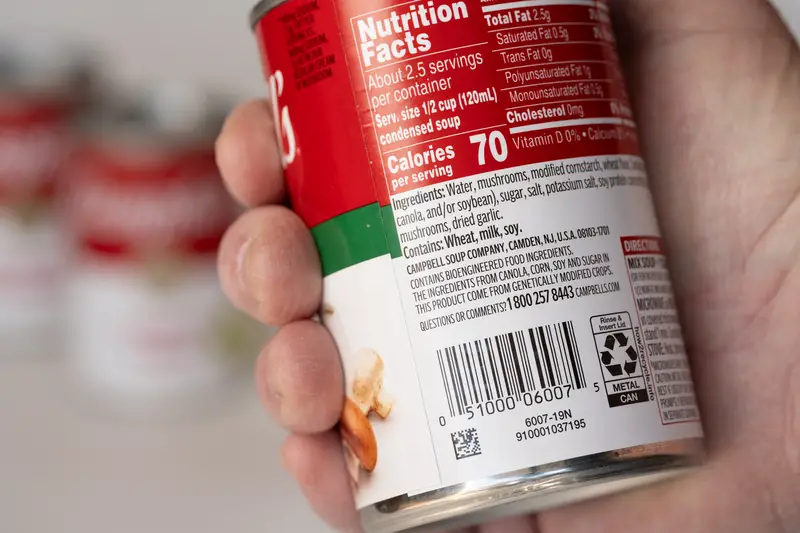
This one isn’t technically an ingredient, but it’s a label trick that makes everything else worse. That can of Campbell’s Tomato Soup you thought was one meal? The label says it contains 2.5 servings. So every number you see on the nutrition panel — sodium, sugar, calories, fat — needs to be multiplied by 2.5 to get the real picture of what you’re eating if you finish the can.
Nobody eats half a can of soup and saves the rest for tomorrow. The manufacturers know this. They use the smaller serving size to make the numbers look more reasonable on the label. Campbell’s Condensed Cheddar Cheese Soup lists 870 milligrams of sodium per serving. Sounds high but not catastrophic. Multiply that by the 2.5 servings in the can, and you’re looking at 2,175 milligrams — nearly your entire daily limit from one food item.
BPA In The Can Lining
This one isn’t on the ingredient list at all because it’s not in the soup — it’s in the can itself. BPA (bisphenol-A) is a chemical used in the interior coatings of many food cans. It’s an endocrine disruptor, which means it messes with your hormones. Specifically, BPA mimics estrogen in your body, either blocking or activating estrogen receptors and throwing your natural hormone balance off.
A Harvard study found that people who ate canned soup daily for five days had BPA levels in their urine that were 1,221% higher than when they ate fresh soup. Their urine contained 20.8 micrograms per liter of BPA after the canned soup phase, compared to just 1.1 micrograms per liter after eating fresh soup. Those are some of the most extreme BPA concentrations ever recorded outside of a factory setting.
The Can Manufacturers Institute claimed in 2019 that nearly 100% of cans now use new linings instead of BPA. But many of those replacement linings use chemicals like BPF that have been known to be harmful since at least 2015. The EU banned BPA in food packaging. The U.S. FDA still considers it safe. If you want to avoid it entirely, look for soups sold in glass jars or TetraPaks instead of metal cans. And if you must buy canned, avoid acidic soups like tomato-based varieties, because acid speeds up the leaching of chemicals from can linings.
What To Actually Buy Instead
All of this sounds pretty grim, but there are decent options out there if you know what to look for. Health Valley Organic No Salt Added Minestrone contains just 100 milligrams of sodium per can — a fraction of what most brands pack in. Amy’s makes a range of organic soups in BPA-free cans with real herbs and spices and no hidden additives. Imagine sells soups in TetraPaks instead of cans, though you still want to read their labels since some of their products flag for MSG-related ingredients.
When reading labels, here’s your quick checklist: look for sodium under 600 milligrams per serving (and check how many servings are in the container). Sugar should be 4 grams or less. No hydrogenated or partially hydrogenated oils. No ingredient names that are aliases for MSG unless you know you’re not sensitive to it. And if you can find it in glass or a carton instead of a can, even better.
Soup has genuine health benefits — it fills you up, helps you eat fewer calories overall, and chicken soup really does have anti-inflammatory properties that can help when you’re sick. But a bad can of soup can deliver more sodium than a bag of potato chips, more sugar than ice cream, and a dose of industrial chemicals that would make a European food regulator faint. Read the label. Every time. It takes 30 seconds, and it’s 30 seconds your body will thank you for.
