

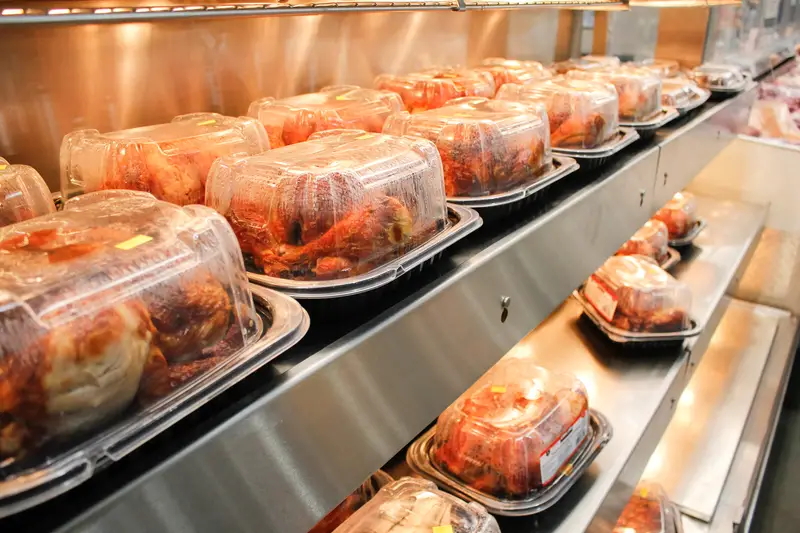
If you’ve ever walked into Costco for paper towels and walked out with a golden rotisserie chicken warming the passenger seat of your car, you’re not alone. Costco sells over 157 million of those birds a year. The $4.99 price tag hasn’t changed since 2009. It’s practically an American institution — the one thing everyone agrees on regardless of politics, income level, or dietary philosophy.
But now, that beloved bird is sitting at the center of not one but two class-action lawsuits. The first accuses Costco of lying about preservatives. The second claims the company’s chicken processing plant has a chronic salmonella problem. Together, they raise some uncomfortable questions about how Costco keeps that chicken so cheap — and whether customers have been getting the full story.
The “No Preservatives” Claim That Wasn’t Quite True
On January 22, 2026, two California shoppers — Bianca Johnston and Anastasia Chernov — filed a lawsuit in the U.S. District Court for the Southern District of California. Their claim is straightforward: Costco plastered “no preservatives” all over its signage and online marketing for its Kirkland Signature Seasoned Rotisserie Chicken, but the ingredient list on the actual packaging told a different story.
Two ingredients — sodium phosphate and carrageenan — were quietly listed in the fine print. Both are commonly used in prepared foods. Sodium phosphate preserves moisture and enhances flavor. Carrageenan thickens and stabilizes meat products. Whether you call them “preservatives” depends on who you ask, but the lawsuit argues that advertising “no preservatives” while including ingredients that function as preservatives is flat-out misleading.
The complaint alleges that Costco “systemically cheated customers out of tens, if not hundreds, of millions of dollars” through this marketing. Johnston bought her chicken at a Victorville, California, location in 2024. Chernov bought hers in San Marcos in 2025. Both say they specifically prefer preservative-free foods — the kind of detail that matters when you’re building a class-action case.
Costco’s Quiet Response Spoke Volumes
Here’s where it gets interesting. Costco didn’t dig in and fight. Instead, the company moved quickly to remove all references to preservatives from its in-store signs and online listings. In a statement, the company said it wanted to “maintain consistency among the labeling on our rotisserie chickens and the signs in our warehouses and online presentations.”
Read that again. Costco didn’t say the lawsuit was wrong. It didn’t argue that sodium phosphate and carrageenan aren’t preservatives. It just quietly pulled the signs down. That’s not exactly a ringing defense of the original marketing. The company also stated that both ingredients are FDA-approved and used for moisture retention, texture, and product consistency. All true. But that wasn’t really the question. The question was whether slapping “no preservatives” on a product that contains preservative-functioning ingredients is honest. Costco hasn’t admitted wrongdoing, but the speed of the signage removal was telling.
A Regulatory Gray Area That Benefits Big Companies
Part of what makes this case tricky is that neither sodium phosphate nor carrageenan is technically classified as a “preservative” under federal regulations. Both fall under the FDA’s GRAS rule — generally recognized as safe. And unlike claims like “low fat,” which have specific legal definitions, the phrase “no preservatives” doesn’t carry a hard regulatory definition.
This is one of those situations where what’s technically legal and what the average person understands are two very different things. If you see a sign that says “no preservatives,” you think the thing has no preservatives. You’re not parsing FDA classifications while standing in the Costco deli section with your cart blocking traffic. The plaintiffs’ attorney, Wesley M. Griffith, put it bluntly: consumers “reasonably rely on clear, prominent claims like ‘no preservatives,’ especially when deciding what they and their families will eat.” Hard to argue with that.
Then Came the Salmonella Lawsuit
As if the preservatives drama weren’t enough, a second lawsuit landed on February 12, 2026 — this one filed in federal court in Seattle. This case has nothing to do with labeling and everything to do with food safety. A Missouri shopper named Lisa Taylor alleges that Costco’s chicken processing plant in Fremont, Nebraska, has a chronic salmonella contamination problem that has gone unresolved for years.
The 37-page complaint cites USDA inspection records showing that Costco’s Lincoln Premium Poultry (LPP) plant has earned the USDA’s worst food safety rating — Category 3 — in 92% of reporting periods since it opened in 2019. The plant reportedly failed every monthly salmonella test from late 2023 through mid-2025. That’s not a blip. That’s a pattern.
Taylor, who regularly bought rotisserie chickens from Costco stores in the St. Louis area, claims she suffered “economic injury” by overpaying for chicken she wouldn’t have bought at the same price had she known about the safety record. The lawsuit doesn’t claim every single chicken was contaminated. It focuses on whether Costco’s supply chain met federal safety benchmarks and whether consumers were kept in the dark.
Costco’s $450 Million Chicken Factory
To understand how Costco ended up here, you have to understand the lengths the company has gone to protect the $4.99 price point. In 2019, Costco opened a $450 million poultry complex in Nebraska. The operation includes hatcheries, feed mills, breeder barns, grow-out barns, and slaughter and processing plants. It’s a full egg-to-shelf pipeline. The goal was vertical integration — control the whole process and keep costs down.
The LPP plant now processes over 100 million chickens every year, exclusively for Costco. According to the animal rights nonprofit Farm Forward, which helped bring the salmonella data to light, 7.2 million birds die from disease or mistreatment before they even reach slaughter. That’s a staggering number, even by industrial poultry standards. Farm Forward’s review of USDA records suggests that more than 1 in 10 whole chickens from the plant destined for the rotisserie arrived at stores contaminated with salmonella, and roughly 1 in 6 packages of raw chicken breasts from the same facility were contaminated.
The Loss Leader That Might Be Losing More Than Money
Costco’s rotisserie chicken has always been what the retail industry calls a “loss leader.” The company sells each bird at a loss — intentionally — because getting you in the door for a $4.99 chicken means you’ll probably leave with $200 worth of stuff you didn’t plan to buy. It’s one of the most effective marketing strategies in American retail, right up there with IKEA’s meatballs and the $1.50 Costco hot dog.
But the lawsuits suggest the cost of keeping prices low may be showing up in other ways. The salmonella lawsuit specifically pins the contamination issues on “conscious business decisions” tied to maintaining the $4.99 price. To maximize efficiency, chickens are bred for rapid growth and raised in large, high-density flocks — conditions that increase stress, disease susceptibility, and the spread of pathogens. In other words, the thing that makes the chicken absurdly cheap might also be the thing making it less safe.
The Plaintiffs Still Plan to Buy the Chicken
Here’s maybe the most relatable detail in this whole saga. Both California women who filed the preservatives lawsuit — the ones who say Costco lied to them — still plan to buy Costco rotisserie chickens in the future. They just want honest labeling. That says something about how deeply this product is embedded in American shopping habits. Even when you feel burned by the marketing, you’re not ready to quit the bird.
The preservatives lawsuit is seeking class certification for anyone in the U.S. who purchased a Costco rotisserie chicken, plus a California subclass. The salmonella lawsuit covers customers who bought rotisserie chicken or raw chicken products after January 1, 2019. Neither case has been certified by a court yet, and no trial dates have been set.
What This Means for Your Next Costco Run
Nothing is changing at the store level right now. The chickens are still $4.99. They’re still sitting in the warmer by the back of the warehouse. Costco sold 157.4 million of them worldwide last year, according to numbers shared at the company’s January 2026 shareholder meeting. In Canada, the same chicken goes for $7.99 to $9.00 — still a bargain compared to similar products at other grocery stores.
But the dual lawsuits mark a shift in how people are thinking about Costco’s most iconic product. For years, the rotisserie chicken was untouchable — a symbol of value in a world where everything else keeps getting more expensive. Now, the question isn’t just “how do they keep it so cheap?” but “what does keeping it that cheap actually cost?” Those are two very different conversations, and Costco is about to have both of them in court.
