

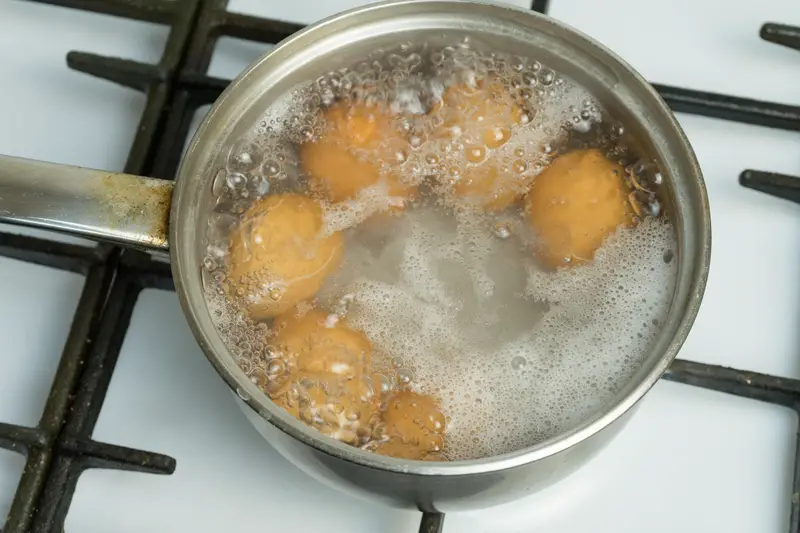
I ruined hard-boiled eggs for years. I’m not talking about minor imperfections — I mean chalky, sulfur-smelling, gray-green disasters that looked like props from a horror movie. And honestly? I thought that was just what hard-boiled eggs looked like. That everybody’s looked like that. Turns out, I was making the same mistake millions of Americans make every single time they boil an egg, and it’s so simple to fix that it’s almost embarrassing.
The thing is, boiling an egg seems like it should be the easiest cooking task on earth. Water, egg, heat. Done. But there are a surprising number of ways to screw it up, and most of us have been screwing it up since the first time we stood in front of a stove. Let’s talk about what’s actually going wrong and how to get eggs with creamy, golden yolks and whites that aren’t made of rubber.
You’re Overcooking Them (And You Don’t Even Know It)
This is the big one. The mistake that towers above all others. If your hard-boiled eggs have a grayish-green ring around the yolk, a dry crumbly texture, or smell vaguely like a locker room, you’ve overcooked them. Chef Nick Korbee from Egg Shop in New York calls this the “Death Star Effect” — the egg gets so brutalized by boiling water that it comes out looking like an imposing gray symbol of everything that went wrong. His description of the flavor is even worse: “something akin to the overly-sulfuric aroma of chronic flatulence.” Lovely.
Here’s what’s happening on a chemical level. According to Dr. Dawn M. Bohn, a teaching associate professor at the University of Illinois at Urbana-Champaign, when you cook an egg too long or at too high a temperature, the sulfur in the egg white combines with the iron in the yolk. This creates a compound called ferrous sulfide, which is that green ring you keep seeing. It’s not dangerous — Dr. Stephanie Smith from Washington State University points out it’s actually the same form of iron found in supplements — but it sure looks and tastes bad.
The fix? Use a timer. Seriously. Stop eyeballing it. Stop wandering off to check your phone and coming back whenever you remember. For a creamy, brilliant yellow yolk, Korbee recommends nine minutes in boiling water. Want them firmer for deviled eggs? Go eleven minutes. But past twelve minutes, you’re entering Death Star territory.
The Cold Water vs. Boiling Water Debate
Here’s where things get interesting, because the experts genuinely disagree with each other. One popular method says to place your eggs in the pot, cover them with cold water, bring everything to a boil together, then remove from heat and let them sit covered for 10 to 12 minutes. The idea is that bringing eggs and water up in temperature together promotes even cooking and prevents cracking.
The other camp — and this includes Korbee and several popular cooking sites — says to boil the water first, then lower your eggs in. Their argument makes a lot of practical sense: everyone’s stove and pot are different. Your water might take four minutes to boil, mine might take seven. If we’re both starting eggs in cold water and timing from the boil, our cook times are already off. But if we both lower eggs into water that’s already at 212°F, we’re working from the same consistent baseline.
And that pot thing isn’t trivial. Aluminum, stainless steel, and cast iron all heat up and retain heat at different rates. If your eggs are sitting in cold water in a heavy cast iron pot, it might take two minutes longer to reach a boil than in an aluminum pot — and the water will cool much slower once you pull it off the heat. That’s a few extra minutes of cooking you didn’t account for, and it’s enough to push you into green-yolk territory.
My take: the boiling-water-first method gives you more control. But either method works if you actually time things properly. The only approach that definitely doesn’t work is winging it.
You’re Skipping the Ice Bath
This one drives me crazy because it’s so easy and so many people just… don’t do it. When your timer goes off, your eggs aren’t done cooking just because you pulled them out of the hot water. There’s still a ton of residual heat inside that egg, and it keeps cooking the yolk even while it sits on your counter. That’s called carryover cooking, and it can easily push a perfectly timed egg into overcooked territory.
The solution is dead simple: have a big bowl of ice water ready. As soon as those eggs come out of the pot, they go straight into the ice bath. This stops the cooking immediately and locks in whatever texture you were aiming for.
But here’s the part most people don’t realize: the ice bath also makes your eggs way easier to peel. The sudden temperature change causes the egg white to contract and shrink away from the shell. Don’t rush this step either. Even eggs that feel cool to the touch might still have heat trapped inside. Let them sit in that ice water for at least 15 minutes before you try to peel them.
Your Eggs Are Too Fresh
This sounds backwards, but it’s true. If you’ve ever peeled a hard-boiled egg and it came apart in chunks, with bits of white ripping off with the shell, your eggs were probably too fresh. As eggs age, two things happen: they lose moisture through tiny pores in the shell, and the pH level of the whites rises. Both of these changes make the whites adhere less to the shell, which means cleaner peeling.
Super-fresh eggs — the kind still warm from the hen at a farmers’ market — are the absolute worst for boiling. But there’s a sweet spot. Eggs that have been sitting in your fridge for a week or two are going to peel much better than ones you just picked up. If you’re planning to make a big batch for meal prep or Easter or whatever, buy your eggs a week ahead of time and let them age in the fridge.
But don’t go too far in the other direction. Really old eggs can give you those chalky, powdery yolks even without overcooking. Check the sell-by date on the carton, or do the float test: put an egg in a glass of water. If it sinks and lays flat, it’s fresh. If it stands upright on the bottom, it’s older but still good — and perfect for boiling. If it floats, toss it.
You’re Cramming Too Many Eggs in a Tiny Pot
I get it. You want to be efficient. You’ve got a dozen eggs and a small saucepan, and you figure they’ll all fit if you stack them a little. Bad idea. When eggs are piled on top of each other, they don’t cook at the same rate. The ones on the bottom are closer to the heat source, the ones on top are partially exposed above the water line, and you end up with eggs at completely different stages of doneness.
Eggs should sit in a single layer at the bottom of the pot with enough room to move around a little. There should be about an inch of water covering the tops of the eggs. If you need to cook more than your pot can handle in one layer, either use a bigger pot or do two batches. It takes an extra few minutes but the results are worth it.
A Few Tricks That Actually Work
Want to make peeling even easier? Try adding a teaspoon of baking soda or a tablespoon of white vinegar to your boiling water. The baking soda raises the pH level, which loosens the bond between the white and the shell. The vinegar supposedly softens the shell by breaking down the calcium. Both methods have their advocates, and honestly either one is worth trying if you’re tired of mangled eggs.
Here’s another good one: store your eggs upside down in the fridge before cooking. This positions the yolk right in the center of the egg, so when you cut it in half for deviled eggs or a salad, everything looks perfectly symmetrical.
And if you’ve already overcooked a batch? Don’t throw them out — eggs are expensive right now. Mash those chalky yolks into a mayo-based filling for deviled eggs or egg salad. The chalky texture disappears completely when it’s mixed with something creamy. Or slice the eggs onto avocado toast, where the green of the avocado camouflages the green ring on the yolk. Nobody will ever know.
The Method That Works Every Time
After testing all of this, here’s what I’ve landed on. Fill a pot with enough water to cover your eggs by an inch. Bring it to a boil. Lower your fridge-cold eggs in gently with a slotted spoon or a skimmer. Reduce the heat just enough that the water stays at a gentle boil — you don’t want the eggs slamming around and cracking. Set a timer for 10 minutes if you want firm but creamy yolks, or 8 minutes if you like them a touch softer in the middle. When the timer goes off, move them straight to a bowl of ice water. Wait at least 15 minutes. Peel. Done.
That’s it. No gray rings, no sulfur smell, no chunks of white stuck to the shell. Just a clean, golden egg that actually tastes the way it’s supposed to. The whole process takes about 25 minutes, most of which is just waiting. And once you nail it the first time, you’ll wonder how you ever got it wrong.
