

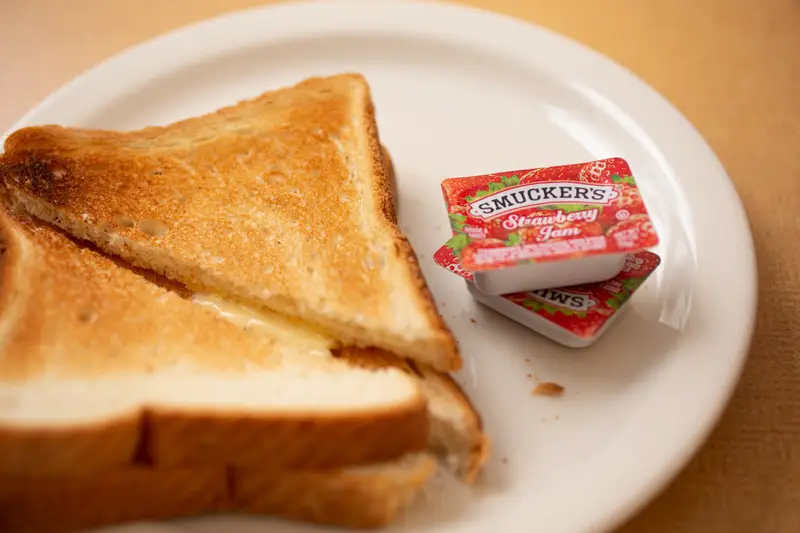
Perfectly good bread gets ruined about four seconds after the toaster pops. The butter comes out of the fridge hard as a hockey puck, the knife tears a hole through the middle of the slice, and whatever survives gets pushed around in a cold yellow clump that never fully melts. Americans do this a lot. Plenty of us go through a loaf a week, and a lot of it ends up as toast.
The fix costs nothing, adds no time, and takes no extra butter. Butter the bread before it goes near the heat, not after. That is the whole move. Everything else in this article is about pulling it off without wrecking your toaster.
The catch is the toaster sitting on your counter
Buttered bread cannot go into a vertical pop-up toaster. As the slice browns, the butter melts and slides straight down onto the electrical components inside the appliance. You end up with no butter on the toast, a toaster that no longer works properly, and possibly, as Mashed warns, the start of a kitchen fire.
Gravity is the reason this works and also the reason it fails. Any setup where the bread lies flat puts gravity on your side: a toaster oven, a skillet, a grill, or a regular oven with a toast or broiler function. Slide a tray under the bread in a toaster oven so nothing hot drips onto the heating elements.
Why the order makes such a difference
Melting butter on a flat slice has nowhere to go but down, so it soaks into the whole piece of bread instead of parking on the surface. You get a crisp top and a rich, soft interior rather than dry toast wearing a cold lump of fat.
Because the butter spreads through the crumb instead of sitting on top, a thin layer goes a long way. Cold butter is fine here since it will melt anyway, though softer butter is easier to spread evenly across the whole slice.
There is a flavor bonus. Cookbook author Raquel Pelzel told Food52 that when you butter first, the fat “seeps down into the crumb” and the top takes on “a glowy/caramelized sheen and a crispness that is so good.” That toasty note comes from the milk solids in the butter browning in the heat.
One more thing in its favor: pre-buttered toast forgives you for getting distracted. Left on the plate for a few minutes, it does not turn into the scratchy brick that plain toast becomes.
Use a vegetable peeler on the butter stick
Butter needs to sit at about 65 to 67 degrees Fahrenheit before it is genuinely soft, and nobody plans that far ahead at 7 a.m. Instead of hacking at a cold stick with a knife, run a vegetable peeler down it and shave off wafer-thin sheets. They come to spreadable temperature almost immediately, they do not tear the bread, and the stick stays neat instead of looking like it lost a fight.
The skillet is the fastest way to do it
Melt a little butter or oil in a skillet over medium heat, lay the bread in, and cook 2 to 3 minutes per side until golden. If you want the oven instead, 350 degrees Fahrenheit for about 10 minutes on the middle rack, flipped halfway, does the job. Under the broiler it is 1 to 2 minutes per side, and you do not walk away, because bread goes from gold to black in seconds.
Skip the cooking spray. An ungreased sheet pan works fine, especially when the butter is already on the bread. Use tongs to flip, since the pan will be hot and the slices are slippery.
Feeding more than two people changes the math
A two-slot toaster is hopeless for a table of five. By the time the last batch is done the first is cold and brittle, and re-toasting only dries it out. The oven rack trick from an America’s Test Kitchen TikTok solves it: move two racks close together, slot a baking sheet between them, then stand the slices upright in the top rack so their bottom edges rest on the sheet. Bake until browned. The circulating heat browns every side evenly, and once the oven is off the same setup holds the toast without letting it go damp.
An oven batch takes about 10 minutes for evenly golden slices, and the texture holds up better under a loaded sandwich than toaster slices do.
If those slices are headed into a sandwich, brown only one side. “I like to toast my bread on one side and then build my sandwich with the toasted side on the inside,” HaiSous owner and chef Thai Dang told Time Out. He said it keeps the sandwich from going soggy while sparing the roof and bottom of your mouth from a scratchy crust, and you still get the texture. A broiler makes that easy; a pop-up toaster makes it nearly impossible.
Plain butter is just the starting point
Cinnamon toast is the obvious upgrade, because the butter and the sugar both caramelize in the heat instead of sitting on top as a gritty layer. Honey butter does the same. Any compound butter sinks into the bread as it melts, so garlic and herb butter turns a plain slice into something closer to garlic bread. Watch that one, because the herbs will scorch before the bread is done.
The same logic applies to anything bready that goes under heat: cornbread, English muffins, bagels. A lightly buttered, toasted bagel takes cream cheese or a full breakfast sandwich better than a dry one.
Have your toppings ready before the bread goes in. Cheese sliced, fruit cut, eggs cooked. Toast that sits on the counter while you dig through the fridge is toast that has already lost its edge.
If you are sticking with the pop-up toaster
Butter it the second it pops. Back in 2011, consultant food researcher Dom Lane, in a study for the bread brand Vogel’s, reportedly toasted 2,000 slices and settled on 216 seconds in a 900-watt toaster, dial at 5 of 6, for the ideal mid-brown. His advice was to butter it right away.
Stop cramming thick slices and fat bagels into the slots. When the bread completely covers the wires, the side touching them burns while the rest stays cool. On the bagel setting, bagels go in with the cut sides facing inward, since the middle wires run hottest, which browns the insides while the outside stays chewy.
Your second batch will come out darker than the first at the same setting, because the toaster is still hot. Dial it back a notch. Empty the crumb tray, and give the whole thing a real cleaning every few months, since a pop-up toaster browns bread with radiant heat from its glowing wires, and a crumb-clogged one heats less evenly. Never poke around in there with a knife or fork, plugged in or not.
Sogginess comes from steam trapped between warm bread and a cold plate. Stand the slices upright and lean them against each other in a tent so the steam escapes upward. Easier still, leave the toast standing in the toaster until you are actually ready to eat it.
What happens before the bread hits the heat
Slice thickness decides your timing. Aim for a consistent half inch to three quarters of an inch; thinner slices burn fast, thicker ones need longer to warm through. Sourdough’s open crumb soaks up butter better than most breads, while brioche, with all that butter and sugar, browns fast, so pull it early.
The refrigerator is the wrong home for a loaf you plan to toast. Cold temperatures speed up the starch changes that make bread go stale, so it slows mold at the cost of texture. An airtight container at room temperature beats it for standard sliced bread. Freeze what you will not finish, pre-sliced and flat, with the air pressed out of the bag, then toast straight from frozen; bump the toaster setting up one or two notches, or use the frozen setting if you have one.
Bread that is only slightly past its best actually toasts well, since the heat dries it out and it holds up under spreads. Bread that has gone genuinely hard needs moisture back first. Wrap it in a damp paper towel, give it about ten seconds in the microwave, then finish it in a toaster oven on the lightest setting. The microwave puts water back into the starch and the toaster oven handles the crust. Bread that is bone dry is croutons, not toast.
The verdict
Butter first, and do it somewhere the bread lies flat. A toaster oven with a tray underneath is the easiest version, the broiler is the fastest, and a skillet gives you the closest thing to fried bread. It is one less step at the table, less butter overall, and a slice that tastes like it came from a diner griddle instead of a slot.
Keep the pop-up toaster for dry toast you butter within seconds of the pop. It was never the right tool for garlic bread, grilled cheese, or anything that melts anyway.
