

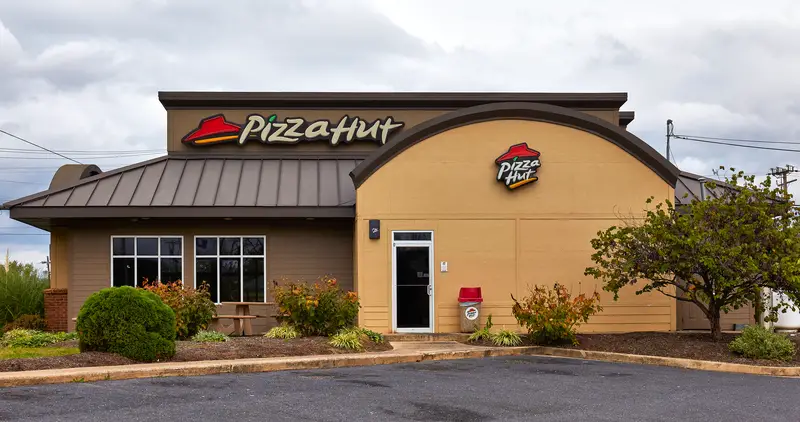
The red roof. The salad bar with the little glass bowls. The stained glass lamp hanging over a vinyl booth while somebody’s dad paid the check. For about thirty years, that building was what pizza night looked like in America. In February 2026, Yum Brands told Wall Street that roughly 250 of those restaurants in the United States would be gone by summer. The chain doing the closing is Pizza Hut, and by the time the year was half over, its parent company had also agreed to sell it off entirely.
250 Stores, And No List Of Which Ones
Yum Brands chief financial officer Ranjith Roy announced the closures on the company’s fourth quarter 2025 earnings call on Feb. 4, 2026. About 250 U.S. restaurants would shut during the first half of the year, all of them underperforming stores. No list of addresses was released, so customers found out the way they usually do, by pulling up to a dark building.
That amounts to roughly 4% of Pizza Hut’s American store count. Yum’s third quarter filing said about 32% of the chain’s 19,872 restaurants worldwide were in the U.S. at the time, which works out to a store base of around 6,360 locations.
Roy downplayed the scale of it on the call. The 250 stores, he said, are a very small portion of the 20,000 unit estate Pizza Hut has globally, and the right answer for the brand as it moves through its strategic review.
The Sales Numbers Behind The Cuts
Pizza Hut’s U.S. same-store sales fell 3% in the fourth quarter and 5% across the full year, according to Yum’s earnings release. Same-store sales measure how existing restaurants perform against the year before, so a 5% drop means the stores still standing were selling less pizza than they did twelve months earlier.
Globally, the brand was down 1% for 2025. The international business was the bright spot, with same-store sales up 1% and strength in the Middle East, Latin America and Asia. Pizza Hut opened nearly 1,200 gross units worldwide during the year. The company was still building restaurants overseas while it was closing them here.
What Hut Forward Actually Is
The closures ran under a program called Hut Forward, which Yum laid out on that February call. Roy described it to analysts as “a vibrant marketing program, modernization of certain technology and franchise agreements and Yum providing a one-time contribution to marketing support.” He framed the whole thing as a bridge to longer term growth rather than a rescue.
Translated out of earnings call language: spend money on ads, update the ordering tech, rewrite the deals with franchisees, and quietly remove the stores that were never going to work. The targeted closures were baked into the plan from the start.
Then Yum Sold The Whole Brand For $2.7 Billion
Yum began reviewing Pizza Hut’s future in November 2025 and said at the time the process could end in a sale. On the February call, chief executive Chris Turner would not say much beyond the timeline. “As of now, we intend to complete the review of options this year,” he told analysts.
They finished early. In a filing dated June 16, 2026, Yum said it had entered definitive agreements to sell Pizza Hut for $2.7 billion in total, subject to purchase price adjustments. The business outside Mainland China went to private equity firm LongRange Capital for about $1.5 billion. Pizza Hut in Mainland China went to Yum China Holdings for $1.2 billion. The China deal closed Aug. 7, 2026, and the LongRange deal closed Sept. 1, 2026, with an additional earn-out of $75 million by 2030 tied to performance.
Selling a company is not cheap. Yum spent $36 million on the review in 2025, including $32 million in the fourth quarter alone, Goldman Sachs and Barclays were hired as financial advisers for the review. The company also wrote off $5 million in franchise incentive assets in 2025 “associated with rationalizing the Pizza Hut estate in preparation for a potential transaction.” Rationalizing the estate means closing restaurants.
The Shrinking Was Not Just An American Story
Pizza Hut’s worldwide store count dropped from 20,225 at the end of 2024 to 19,974 at the end of 2025. A big chunk of that came from one country. Yum terminated its master franchising agreement with its Turkish operator in early 2025, which shut 254 Pizza Huts in Turkey.
Britain took a hit too. The chain closed nearly 70 locations in the United Kingdom over the same stretch.
Papa John’s Is Cutting Even Deeper
Three weeks after Pizza Hut’s announcement, Papa Johns said on its own Feb. 26, 2026 earnings call that it would close about 300 restaurants: roughly 200 in 2026 and another 100 in 2027. The chain had about 3,500 locations at the end of 2025. North American same-store sales fell 5.4% in the fourth quarter.
The company also cut about 7% of its roughly 700-person corporate workforce. The stores getting closed are the ones not meeting brand standards or with no clear path to improvement, plus locations close enough to another store that the orders can be absorbed. The menu is changing too: Papadias and Papa Bites were set to come off the menu in the second quarter, while toasted sandwiches were in testing in North America and chicken tenders in the U.K. Chief executive Todd Penegor said in November 2025 that the company was “open-minded” to acquisition opportunities, after addressing reports of a $2.1 billion takeover bid that was allegedly withdrawn.
Domino’s Is The One Chain Still Winning
While its two biggest rivals were closing stores, Domino’s posted 3.7% same-store sales growth in the fourth quarter of 2025, with improvement across every income group. Chief executive Russell Weiner opened his earnings remarks by arguing the problem is not pizza.
“There seems to be a narrative out there that pizza is a challenged and declining category,” Weiner said. “That is just not true. Looking back to 2019, you’ll find a category that has generally grown approximately 1% to 2% per year, including last year. … The pizza category is certainly mature, but do not let the challenges at some of our higher-profile competitors drive a false narrative. … Their results are a direct reflection of our strength.”
He has the receipts. Domino’s spent years refusing to list on delivery apps, then signed with Uber Eats in 2023 and DoorDash in 2025, turning both delivery and carryout into growth. It leaned into discounting with Boost Weeks and its Best Deal Ever promotion while other chains treated discounts as a warning sign. In October 2025 it rolled out new colors, new fonts and its first jingle, performed by Shaboozey. Still, the broader category has been bleeding: Technomic’s Top 500 data shows 61% of pizza chains had declining sales in 2024.
How Pizza Hut Got Here
Pizza Hut was founded in 1958. The red roof debuted in 1969, and by 1971 it was the highest-grossing pizza chain in the world. Then Domino’s built its business on fast delivery in the 1980s, the Great Recession pushed Americans toward cheap takeout, and Pizza Hut’s U.S. same-store sales fell 12% in the fourth quarter of 2009 alone.
The real mismatch was the buildings. By 2019, about 90% of Pizza Hut’s business was off-premises, meaning delivery and carryout, yet close to half its restaurants were still sit-down dine-in venues, many of them dropped into neighborhoods that had changed completely over four decades. Those dining rooms cost money to run and heat. Meanwhile Domino’s was putting up small delivery and carryout shops for roughly $425,000 apiece.
Pizza Hut’s answer was a $130 million turnaround investment from Yum in 2017 and a shift to delco stores, the stripped-down delivery and carryout format. The Red Roof dine-in format was officially retired. Around 950 U.S. restaurants have closed since that shift began in 2019. The 250 cut this year is the latest round, not the first one.
Pizza Hut Is Not Unpopular, It Is Oversized
Here is the strange part of the whole story. Pizza Hut was the chain Americans most often named best for pizza in YouGov’s 2026 U.S. restaurant rankings, the same year it closed 250 American restaurants and got sold. People like the pizza. They just are not driving to a 1970s building to eat it in a booth.
The pain is not limited to pizza either. Wendy’s said in November 2025 that a mid-single-digit share of its U.S. restaurants, roughly 300, would close. Jack in the Box said in April 2025 it would shut up to 200 underperforming locations. Darden announced in February 2026 it was ending Bahama Breeze, shutting 14 restaurants in April and converting the other 14 into sister brands over the following 12 to 18 months.
My read: Pizza Hut is not dying, it is being resized and handed to someone else. It got 250 stores lighter, split in two, and sold to a private equity firm and a Chinese operator for $2.7 billion between them. If your local Hut survived the first half of 2026, it survived because it was making money. The ones that went dark were the ones losing it, which is exactly why nobody at Yum wanted to publish the list.
