

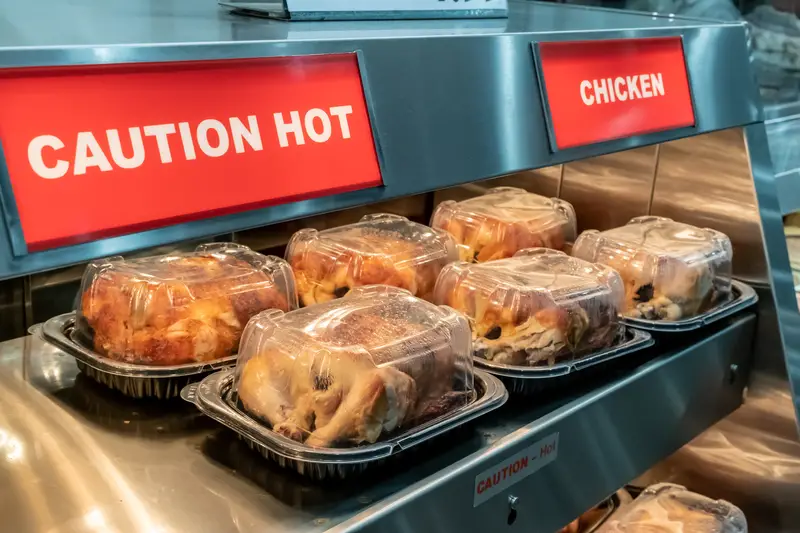
At six o’clock the chickens under the heat lamp all look the same. Golden, hot, sealed in plastic, priced like an afterthought at the end of a long day. They are not the same. Some have been sitting for hours and have quietly dried out. Some weigh a full pound more than the sticker claims. And the most famous bird in America, Costco’s $4.99 Kirkland Signature, is now the subject of a proposed class-action lawsuit in federal court in San Diego that says the label is not telling shoppers the truth about what is inside it.
Costco’s bird is being sued over two ingredients
Two California shoppers brought the complaint. It points at how Costco marketed its Kirkland Signature Seasoned Rotisserie Chicken as containing no preservatives, while the chicken contains sodium phosphate and carrageenan. Costco has since pulled the “no preservatives” line from its signs, and the price is still $4.99. The plaintiffs say those additives stabilize texture and moisture and therefore work like preservatives. The suit claims some customers would not have bought the chicken at all, or would not have paid $4.99 for it, if they had known.
These are allegations in a filing, not findings. Costco has asked the judge to throw the case out, and no court has ruled. The scale is what makes it interesting: Costco reported selling about 157.4 million rotisserie chickens globally in its 2025 fiscal year, which means an awful lot of carts have rolled past that label without a second look.
Sam’s Club won the blind taste test, not Costco
Consumer Reports put rotisserie chickens from 10 stores through a blind tasting, with secret shoppers buying samples at up to three locations on different days and delivering them to the lab while they were still warm. The winner was the Member’s Mark Seasoned Rotisserie Chicken from Sam’s Club. A paprika rub gave it a bronzed color, and the meat came out moist and juicy with a deep roasted flavor and hints of onion and garlic. It costs $4.98 for 3 pounds, or $1.66 per pound.
Costco’s was one of the plumpest birds in the test, moist and well seasoned, at $4.99 for 3 pounds. The knock on it was consistency: the saltiness changed from sample to sample. If you carry both memberships, the Sam’s Club bird is the better plate of chicken for a penny less.
Pick the package up before you pay for it
Many of the chickens bought for testing weighed more than the label claimed. Whole Foods birds averaged a whole pound heavier, which dropped the real cost from $5.14 per pound to $3.26 per pound. That is not an accident. “This is often done intentionally,” says Yan Campbell, PhD, an assistant professor in the Prestage department of poultry science at North Carolina State University in Raleigh. Meat labeling laws require a net weight statement on packaging, and the simplest way to satisfy it is to make sure every bird clears the stated weight.
So the chickens in the case are not identical units, and the one you grab first is not necessarily the one you want. Lift two or three. Take the heavy one. You are being charged a flat price either way.
The price per pound is where stores separate
The warehouse clubs are in a different league on math. Sam’s Club and Costco both land at $1.66 per pound for a 3-pound bird. Walmart’s Traditional Fully-Cooked rotisserie chicken is $5.97 for 2.25 pounds, which works out to $2.65 per pound, and it tasted well seasoned with hints of lemon and rosemary.
Then it climbs fast. Stop & Shop’s whole rotisserie chicken is $7.99 for 1.75 pounds, or $4.57 per pound. Wegmans’ plain roasted chicken is $9.99 for 2.13 pounds, or $4.69 per pound. Whole Foods’ Classic is $8.99 for 1.75 pounds, a sticker price of $5.14 per pound. You are paying roughly triple the club price for a smaller bird, and the testers did not find the supermarket versions three times better. Stop & Shop’s actually looked rough, with shriveled skin and two samples that came close to burnt, though the meat underneath was flavorful and tender.
Shriveled skin is the giveaway
A fresh bird has taut, shiny skin stretched over plump meat and an even golden-brown color. Wrinkled, baggy or deflated skin means the chicken has been sitting too long under the lamp and the juice has cooked out of it. Dull skin is a red flag too, and so is any gray or green patch on the skin or meat. Pale skin can mean it never browned properly, and browning is where most of that roasted flavor comes from.
Liquid pooled in the bottom of the bag is fine. “Poultry releases moisture during cooking and while it rests,” says Amy Keating, RD, a Consumer Reports nutritionist. The opposite is the problem. A container with no juice in it at all suggests there was not much moisture there to begin with.
Some stores stamp the time on the package. If yours does not, ask the counter when the last batch went out. It is a 10-second question that tells you more than anything printed on the label, and once the bird is home, get it into the fridge within two hours and finish it within four days.
Almost every bird is injected before it cooks
Most rotisserie chickens are pumped with a brine containing salt or sodium ingredients such as sodium phosphate before they ever hit the spit. Of the 10 store chickens tested, only the Whole Foods birds skipped it. Brining cuts water loss during cooking so the meat stays juicier, says Sam Watson, PhD, an assistant professor of meat science at Pennsylvania State University in University Park. Brines also commonly carry sugar, natural flavors and carrageenan, which helps hold moisture.
How much solution goes into any one bird varies, and so does what comes out the other end. Lab results on salt content generally came in under what the stores listed, sometimes by a lot. Two samples of the same ShopRite chicken tested 30 percent and 69 percent below the store’s own number. A Wegmans spokesperson explained that the figure on the label represents the maximum that could be in a serving, and the real amount depends on how much injection solution was used. The takeaway for a shopper is simple: two chickens with the same label are not the same chicken.
One Nebraska plant makes most of Costco’s chicken
Costco built its own supply chain to protect that $4.99 price. Lincoln Premium Poultry opened a $450 million complex in Fremont, Nebraska, in 2019, and it runs more than 100 million chickens a year through for Costco’s rotisserie birds and Kirkland Signature raw breasts. An analysis of USDA inspection records by the advocacy group Farm Forward found the plant has landed in Category 3, the agency’s failing salmonella rating, 92 percent of the time since it opened.
What makes that stick is the regulatory gap behind it. The USDA posts those ratings publicly but cannot order a recall, halt sales or close a plant over them. In 2024 the agency’s Food Safety and Inspection Service proposed a framework that would have declared raw chicken carrying high levels of certain salmonella strains adulterated, which would have kept it off the market. That proposed rule was withdrawn in April 2025. Rotisserie chickens are fully cooked before they are sold, but cooked is not bulletproof: in 2013 the CDC linked at least 25 salmonella illnesses to rotisserie chicken from a single Costco in South San Francisco.
The packaging got tested too
Testers checked the containers and the meat for compounds found in plastic. Phthalates turned up in every chicken except ShopRite’s. Costco’s and Walmart’s were the two flagged as high enough to raise a concern, and the recommendation attached to both was that adults have no more than 6 ounces a day of either brand’s chicken. For context, that is roughly two servings off a single bird.
So which one should you actually buy
Sam’s Club. It won the tasting outright, it ties for cheapest per pound at $1.66, and at 3 pounds it feeds more people than anything in a regular supermarket case. Costco ties it on price and comes close on flavor, with the caveat that its seasoning is less consistent bird to bird and its label is being argued over in court.
No membership? Walmart at $2.65 per pound is the best value in a normal grocery store, and it tasted the part. The Wegmans plain bird, seasoned with sea salt only, and the Whole Foods Classic, dressed in salt and cracked black pepper, are the ones for people who want roasted chicken flavor without a brine behind it, as long as you accept the sticker price. Whole Foods’ birds also tend to run heavy, so the real per-pound number is friendlier than the shelf tag suggests.
Whichever case you are standing in front of, the warning is the same. Do not grab the first one. Look for taut, even, golden skin, pick up two and take the heavier one, make sure there is juice in the bottom of the bag, and ask when the batch came out. The chicken is cheap. The one that has been spinning since lunch is not a better deal than the one that went out 20 minutes ago.
