

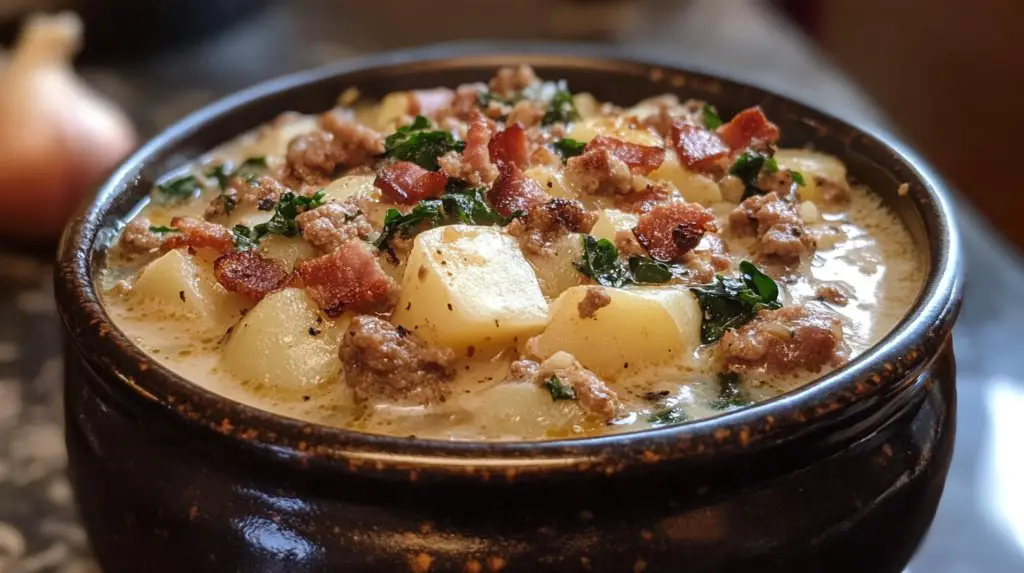
The soup, salad and breadsticks deal is the only reason a lot of people walk into an Olive Garden at all. The salad bowl gets refilled, the breadsticks keep landing on the table, and the server asks which soup you want before anybody has opened a menu. Most tables answer the same way. Zuppa Toscana, the creamy potato soup loaded with spicy Italian sausage, potatoes and kale, is the one that tops side-by-side rankings of the chain’s four soups, and it happens to be the easiest thing on that menu to rebuild at home in one pot.
What Is Actually In The Restaurant Bowl
Olive Garden’s own menu describes it as spicy Italian sausage, kale and potatoes in a creamy broth. No bacon. No pasta. No beans. No tomato. The chain has been serving Italian-American food since it opened in Orlando, Florida, in 1982, and the soup looks exactly like something a line cook can keep going in one pot all day, because that is what it is.
A to-go bowl ran $8.99 at the Monroe, North Carolina, location in an October 2026 review, and prices vary by location. A single pot at home starts with a pound of sausage and five potatoes and feeds eight people. That math is the entire argument for making it yourself.
It Is Not Really Tuscan, And That Is Fine
Zuppa Toscana translates to Tuscan soup, and in Italy it is not one recipe. It covers a whole range of soups eaten in Tuscany, from light vegetable and bean versions to heavy ones thickened with spelt and corn flour. One of the most representative is Minestra di Pane, or bread soup, made with cannellini beans, tomatoes, cabbage, kale and slices of day-old bread layered in to soak up the liquid. Ribollita works the same way, with stale bread boiled right into the pot. Minestrone belongs to the same family.
The heavy cream and the sliced potatoes are American additions, and so is the bacon most copycats add. Kale is the one piece that holds up, since lacinato kale, sold in American stores as Tuscan kale, grows easily in the region. Potatoes did not become an everyday Italian food until the 1800s. Treat it as an American soup with an Italian accent, cook it anyway, and stop apologizing for it.
The Sausage Choice Decides Everything
Hot Italian sausage is what gives the soup its signature kick, and the copycat versions that taste closest to the restaurant all start there. Buy it in bulk if your store sells it that way. If you only find links, slit the casings and squeeze the meat out before it hits the pot.
Mild sausage is a legitimate choice if there are kids at the table, but it needs backup. A teaspoon of crushed red pepper flakes stirred in while the meat browns puts the heat back, and a half teaspoon of crushed fennel seeds adds the sweet anise note you taste in good Italian sausage. You can also leave the pot mild and set out red pepper flakes so everybody spices their own bowl.
Slice The Potatoes Thin, And Slice Them Even
Russets are the traditional pick, peeled and cut into quarter-inch pieces, or sliced even thinner at about a sixth of an inch. Thin slices are the point. They cook in 13 to 14 minutes, soften at the edges, and release just enough starch to give the broth some body before the cream ever shows up. A mandoline makes short work of it and keeps every piece the same thickness, which is the real reason some batches come out with half the potatoes mushy and half still firm.
Gold potatoes are the shortcut. Their skins are thin enough that you can skip peeling entirely, and a pound and a half diced goes into the pot skin and all. They hold their shape better than russets and simmer tender in 10 to 12 minutes. If you want the soup on the table in about 40 minutes flat, that is the version to make.
Use A Whole Head Of Garlic
An entire head, about 10 large cloves, peeled and minced or pressed. It sounds absurd next to the two or three cloves plenty of copycats call for, but the garlic goes in after the onion for one minute, then spends the next 15 minutes simmering in broth. Simmered garlic mellows out. What it leaves behind is the deep, round savory flavor that separates a real copycat from a pot of sausage and potato water. Jarred garlic will work in a pinch, but fresh is noticeably better here and it is the cheapest upgrade in the recipe.
Go Easy Once The Cream Goes In
Cream is the last thing in the pot, and it goes in over low heat. Heavy cream can handle the soup coming back to a gentle bubble, which is how the top-rated copycat finishes it, but pull the pot off the heat right then instead of letting it roll. Half and half and milk are touchier and can split, so with those, stop at steaming hot.
One cup of heavy whipping cream is standard for a full pot. Two cups of half and half gives you a thinner, lighter broth, and if your store is out of half and half you can make your own with one cup of low-fat milk and one cup of cream. For a dairy-free pot, one can of full fat unsweetened coconut milk works, using only the solid white cream portion and adding it at the very end just to heat through.
Want it thicker without more cream? Mix a tablespoon of cornstarch with a tablespoon of cold water until smooth, then stir the slurry into the broth. Dissolve it first. Dumping dry cornstarch into hot liquid gives you lumps you will never get out.
The Kale Looks Like Too Much. It Is Not
Strip the leaves off the stems of one bundle and chop them fine. You will end up with roughly six cups piled in the bowl, and it will look like enough kale for a salad bar. It collapses in about five minutes in hot broth and practically disappears into the soup. Leaner versions use as little as a cup and a half packed, so adjust to the amount of green you actually want on your spoon.
Why Homemade Batches Taste Flat
The complaint that comes up over and over from people who try this at home is that their soup tastes thinner and duller than the restaurant’s. The fix is almost always salt, and it comes at the end. Season after the cream, taste, then taste again. Restaurants salt harder than home cooks do, and that gap is most of the difference.
Start with low-sodium chicken broth so you stay in control of it, since the bacon and sausage are already bringing plenty of their own. A bay leaf dropped in with the potatoes adds a quiet earthy note underneath everything. Pull it out before serving.
Serving It And Keeping It
Crumbled bacon on top is not optional, and neither is cheese. Freshly grated Parmesan is the usual call, though finely shredded Romano is sharper and worth trying. Red pepper flakes go on the table. For bread, warm breadsticks or garlic bread do the restaurant thing, and thick slices of sourdough or crusty French bread do it better. A simple Caesar or Italian side salad rounds it out.
Cooled leftovers keep covered in the fridge for three to four days, and the flavor improves overnight. Do not freeze it. Cream and potatoes both turn grainy once thawed. Reheat gently on the stove over medium-low heat or in the microwave until steaming, stopping short of a boil, and store the bacon in its own container so it stays crisp for the second round.
The Verdict
Made right, the homemade pot beats the restaurant bowl, and it is not close. You get more sausage, more potato, bacon the restaurant bowl does not have, and less broth per spoonful, and you decide how hot and how creamy it ends up. Slice the potatoes thin, use the whole head of garlic, keep the heat down once the cream is in, and salt it properly at the end. The whole thing takes a little over an hour, and it makes eight bowls.

Copycat Olive Garden Zuppa Toscana
Cuisine: Italian8
servings35
minutes35
minutes458
kcalOlive Garden’s Zuppa Toscana, rebuilt in one pot with hot sausage, bacon, thin-sliced potatoes and a whole head of garlic.
Ingredients
6 oz bacon, chopped
1 lb hot Italian sausage, casings removed
1 medium onion, finely diced
1 head of garlic (about 10 large cloves), peeled and minced
6 cups low-sodium chicken broth plus 4 cups water
5 medium russet potatoes, peeled and sliced 1/4-inch thick
1 bay leaf
1 kale bundle, leaves stripped and chopped (about 6 cups)
1 cup heavy whipping cream, plus salt, black pepper, grated Parmesan and red pepper flakes to serve
Directions
- Add the chopped bacon to a large pot or 5.5-quart Dutch oven over medium-high heat. Saute until browned, 5 to 7 minutes, then lift it out onto a paper-towel-lined plate. Spoon off the excess fat, leaving about 1 tablespoon in the pot.
- Add the sausage to the same pot and break it apart with a spatula as it cooks. Brown it all the way through, about 5 minutes, then move it to a paper-towel-lined plate with the bacon.
- Drop the diced onion into the drippings and saute 5 minutes, stirring now and then, until soft and golden. Add all of the minced garlic and cook just 1 minute more, until it smells strong. Do not let the garlic brown.
- Pour in the chicken broth and water and bring the pot to a boil, scraping up anything stuck to the bottom. Add the sliced potatoes and the bay leaf.
- Cook the potatoes 13 to 14 minutes, or until a fork slides through a slice with no resistance. Thinner slices will finish faster, so start checking early if you used a mandoline.
- Stir in the chopped kale and the cooked sausage and bring everything back to a light boil. The kale will look like far too much at first and will wilt down in about 5 minutes. Fish out the bay leaf.
- Turn the heat to low and stir in the cream. Warm it through until the soup is steaming, keeping it under a hard boil so the broth stays smooth, then take the pot off the heat.
- Season generously with salt and black pepper, then taste and season again. Ladle into bowls and top each one with the crisp bacon, grated Parmesan and a pinch of red pepper flakes.
Notes
- Mild Italian sausage works if you want it kid-friendly. Add 1 teaspoon of crushed red pepper flakes while the meat browns, or a half teaspoon of crushed fennel seeds, to get the flavor back.
- Gold potatoes can replace the russets and do not need peeling. Use 1 and 1/2 pounds diced, and simmer 10 to 12 minutes until fork tender.
- For a thicker broth, dissolve 1 tablespoon of cornstarch in 1 tablespoon of cold water and stir the slurry in with the cream. Leftovers keep 3 to 4 days in the fridge and do not freeze well.
Frequently Asked Questions
Q: Can I use mild Italian sausage instead of hot?
A: Yes, and plenty of people do. The soup loses its kick, so add about a teaspoon of crushed red pepper flakes while the sausage browns, or set flakes on the table so everyone can spice their own bowl.
Q: Can I freeze the leftovers?
A: No. Cream and potatoes both turn grainy once thawed. Cool the soup completely, refrigerate it covered for three to four days, and reheat gently on the stove over medium-low heat without letting it boil.
Q: Russet or gold potatoes?
A: Russets are the traditional choice and give the broth more starch, but they need peeling. Gold potatoes have thin skins, go in unpeeled, and hold their shape better. Either way, slice them thin and keep the pieces the same size.
Q: Why did my broth separate?
A: Most likely it boiled hard after the dairy went in. Half and half and milk split far more easily than heavy cream. Add the dairy over low heat, bring the soup up to steaming, and reheat leftovers slowly instead of blasting them.
