

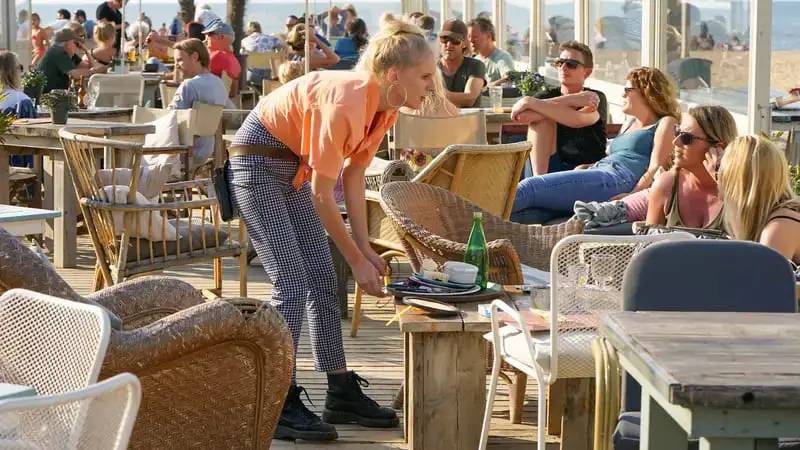
The check is paid, the table is a wreck, and you want to be useful. So you scrape the last of the fries onto one plate, stack the rest into a tidy tower, balance the silverware on top and slide the whole thing toward the edge of the table where your server can grab it in one trip. Helpful. Considerate. The sort of thing a good guest does.
Servers hate it. Stacking your dirty dishes is the classic well-meaning move that quietly makes a restaurant worker’s shift harder, and almost nobody doing it has any idea.
Leave The Plates Where They Are
Leslie Kalk, a restaurant and hospitality coach, put it bluntly to Reader’s Digest: “Stacking plates when done sends a signal to other diners that the waitstaff is not tending to the table properly, and the act of doing so exposes the stackers as inexperienced diners.” There is also a practical problem. Waitstaff have a well-practiced system for clearing plates, utensils and glassware, and your tower interferes with it. The stack wobbles. Sharp knives disappear under a dinner plate. Food smears across the bottoms of everything, which means the server is now carrying a greasy pile at chest height through a crowded dining room.
There is a second casualty. Servers read your utensils to figure out whether you are finished, and a stack erases those signals completely. While you are at it, stop putting your napkin on your plate. Etiquette coach Maryanne Parker, founder of the etiquette firm Manor of Manners, says a cloth napkin dropped onto a dirty plate just picks up more food and makes a bigger mess when the table gets cleared. It goes to the left of the plate, on the table. Sit back and let them work.
One-Timing Is So Common It Has A Name
Extra napkins. Then a side of ranch. Then lemon for the water. Then a spoon for the soup. Then more ice. Each request is perfectly reasonable on its own, and every one of them is a separate lap to the kitchen and back. Servers call it one-timing, and when someone is running eight tables during a dinner rush, a table that summons them five times in ten minutes wrecks the whole rhythm of the section.
The fix takes about four seconds of thought. When your server asks if you need anything else, do a quick mental inventory and ask for all of it at once. Families with small kids and parties larger than eight are the biggest offenders, so if that is your table, poll everybody before the server walks up. Chronically thirsty people have an easy workaround too: ask for an extra glass of water when you order your drink and stop flagging someone down every twelve minutes.
Walking In At 9:59
If the sign says the kitchen closes at 10 p.m., strolling in at 9:59 and ordering a three-course dinner is a choice. The restaurant may well seat you. That does not change the fact that breakdown started hours earlier, stations are already being shut down, equipment is being scrubbed, and the servers still have side work, checks to close and stations to restock before anyone goes home.
Last-minute arrivals are a classic server gripe, and the reason is simple math. Your leisurely hour at 10 p.m. is an unpaid hour tacked onto someone else’s shift. If you truly cannot get there earlier, order something fast, eat it, tip well and go. The same logic applies at the other end of the night: lingering long after close forces staff to keep the lights on and the dining room open for you alone.
Announcing That You’re In A Rush
Sitting down and immediately telling your server you have a flight to catch does nothing except transfer your stress to a person who cannot do anything about it. No server can make a steak cook faster or jump you ahead of the four tickets already hanging in the kitchen, and asking where your food is ten minutes after ordering reads as rude by most servers’ standards. Some will try to help by ringing you in fast and dropping the check early. The cook line does not care about your calendar.
Time management belongs to the customer. If you have thirty minutes, that is a fast casual counter or a drive-thru, not a sit-down restaurant with a full kitchen. Ordering a well-done steak while announcing you are in a hurry is the version of this that servers tell stories about for years.
Asking To Split The Check After Everything Is Rung Up
Modern point-of-sale systems can split a check. That is not the issue. The issue is asking for it after the entire table has been rung in together, which forces the server to go back and split the whole order out item by item. With a group of ten, shared appetizers and two bottles of wine, that is a long stretch of standing at a terminal doing arithmetic while four other tables wait on drinks.
Say it at the start. The first time your server comes to the table, tell them it is separate checks, and the problem evaporates. The other half of this is staggering your party’s arrival without warning. Servers plan the pace of a meal around how many people are sitting down, so when half the group shows up twenty minutes after the other half has ordered, somebody’s entree sits under a heat lamp while somebody else is still working on an appetizer.
Letting Your Kids Run The Dining Room
Family-friendly does not mean the aisles are a playground. Servers move through tight spaces carrying hot plates, full beverage trays and sharp utensils, and a kid darting out of a booth is a collision waiting to happen. It applies at a casual buffet exactly as much as at a nice place.
Restaurant workers get that parenting is hard and that babysitters are expensive. They also know that childcare is not in their job description, and neither is cleanup that goes beyond the normal wreckage. Spills happen, crumbs happen, a dropped chicken tender happens. Food scattered across the floor and chairs with no attempt to contain the mess is a different thing, and so is stuffing used napkins and trash into your water glasses.
Camping At The Table
Etiquette expert Jan Goss, founder of Show Up Well Consulting and author of Protocol Power, gives a clear benchmark: “Servers expect people to stay around one hour for a meal, give or take 30 minutes.” Nobody wants you to inhale your food. But a table you are sitting at for two hours after paying is a table the server cannot turn, and turnover is income for them.
Read the room. If there is a line out the door, wrap it up, especially once your server has swung by two or three times after the check was settled. If the place is half empty on a Tuesday, stay and talk. Goss suggests tipping a little extra when you do, which is the right instinct: you are paying for the real estate.
Snapping, Whistling And Waving Across The Room
Snapping your fingers at an adult human is the fastest way to become the table the staff talks about in the back. Whistling and yelling across the dining room are no better, and neither is waving both arms like you are landing a plane. It makes a server feel summoned rather than hired. Eye contact and a small raised hand does the job.
Two cousins of this one: grabbing a drink off a loaded tray before the server sets it down, which can tip the whole thing onto the floor, and blaming the server for an overcooked steak they never touched. Tell them what is wrong, calmly, and let them fix it. Getting angry at the person carrying your plate does not speed up the kitchen.
Rebuilding The Menu From Scratch
Dressing on the side is fine. Sauce on the side, no onions, swap the fries, all fine. Ordering the beef dinner but with fish instead, a different potato and a double salad is not an order, it is a new recipe. Kitchens run like assembly lines, with each station firing specific components in a set sequence, so a table of invented dishes slows down every other ticket on the rail.
Changing your mind after the ticket has already gone in is the same problem with worse timing. Once the line has started your dish, a modification is effectively a brand new order, and the plate you were supposed to share with the table gets held or thrown out. Decide before you say the words out loud, and if you are unsure about an ingredient, ask then, not after.
Still Tipping 15 Percent
The old ladder was 10% for poor service, 15% for good service and 20% or more for someone who went above and beyond. Etiquette coaches have retired that ladder: Parker puts the appropriate tip at 20%, minimum, for competent service, not as a reward for excellence. Plenty of diners have not caught up. In a Pew Research Center survey of 11,945 U.S. adults in August 2023, 57% said they would tip 15% or less for an average sit-down meal, and only a quarter said 20% or more. Bankrate’s 2025 tipping survey found just 35% typically tip at least 20% at sit-down restaurants.
If you object to tipping culture, fair enough. Your server did not design it and counts on tips for the majority of their pay. As Parker puts it, “Remember, frugal and cheap are two different things.” Leaving nothing after someone fixed a wrong order and handled your table’s five special requests is not a protest, it is just a stiff.
What A Good Table Actually Looks Like
Being an easy table costs nothing. Say hi when the server greets you. Tell them you need five more minutes instead of letting them stand there while you read the menu for the first time. Put the phone down for the ninety seconds it takes to order. Ask for the ranch, the extra napkins and the second water in one breath. Mention the split checks up front. Leave the plates alone, napkin to the left, and tip 20 percent.
Goss frames the whole thing in a way that cuts through the fork-and-knife stuff: “At its core, etiquette is about showing kindness and respect for another human being, in this case, a human being who is providing a service to you.” The stacked plates were always about you feeling helpful. Skip them, and do the things that actually help instead.
