

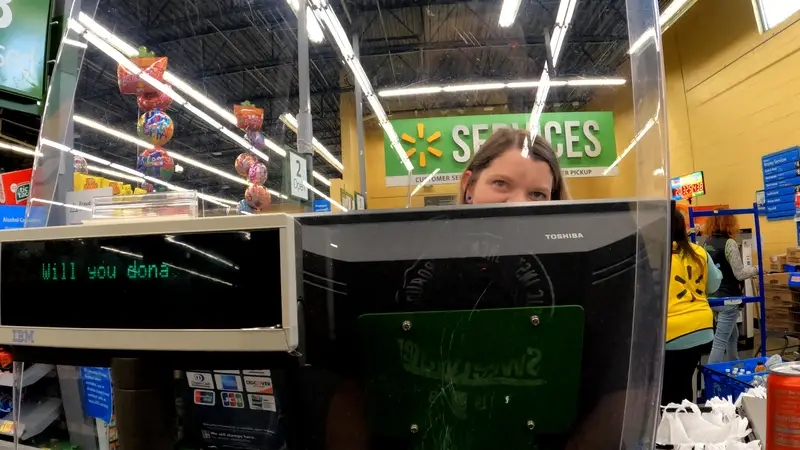
A full cart, a screen that wants you to look up bananas by name, and a recorded voice reminding you to place the item in the bagging area. That is the front end of a lot of American supermarkets now, and one generation flatly refuses to pretend it works. Baby boomers, born between 1946 and 1964, put self-checkout at the top of their list of grocery store irritations, ahead of moved aisles, app-only sale prices and empty shelves. Asked to choose between a self-checkout line and a cashier line of the same length, 62% of shoppers 65 and older took the cashier, according to a YouGov survey. Just 34% picked the machine.
The Split At The Front Of The Store
The preference flips almost exactly by age. Among 18 to 29 year olds, 52% said they would rather use self-checkout and only 26% wanted a cashier. Shoppers aged 45 to 64 land in the middle, with 50% choosing a cashier and 44% choosing the machine. One separate survey found 75% of respondents 55 and older prefer a human cashier, while 46% of Americans between 18 and 34 would pick the kiosk given the choice.
Younger shoppers list real reasons for liking the machines: they bag their own groceries the way they want, they skip small talk, and they think it is quicker. Older shoppers are looking at the same setup and doing different math.
Free Labor Is The Complaint That Repeats
Strip away the generational jokes and the objection is consistent: the store cut a job and handed the work to the customer. Boomers describe self-checkout as unpaid labor, and the specifics come up again and again. Weighing produce is the worst of it, because it means hunting for a code that may not exist on the screen. The system is confusing when it errors out. There is no one to talk to. Some shoppers are so opposed that they will leave a full cart in the store and walk out if no human register is open.
One boomer blogger who swore off the machines wrote that she had needed to call for assistance as many as five times in a single trip, and that she once got pulled out of line at a Costco exit for missing a bag of walnuts while ringing herself up on the app. She also timed herself ordering at a fast-food touchscreen, roughly four minutes, against under one minute telling a cashier the same order. “You’ll never convince this old boomer that self-serve is better than a real person,” she wrote. Her one exception is Uniqlo, where you drop everything in a bin and a scanner reads the whole pile at once.
Chains Are Already Trimming The Kiosks
The pushback is not only coming from customers. Walmart store managers have been enforcing item limits at automated registers and turning away shoppers who roll up with a heaping cart, and Target and Dollar General have cut back on automated lanes too. Theft and inventory losses drove most of that, not sympathy for anyone’s blood pressure. The effect is the same either way: more staffed registers than a couple of years ago.
The Sale Price Now Lives On A Phone
Second on the list of grievances is the disappearing paper coupon. Weekly specials increasingly have to be clipped to a loyalty account in an app, which means the shelf tag price and the price you actually pay are two different numbers depending on what is in your pocket. Pew Research Center reported in 2025 that 78% of adults 65 and older owned smartphones, compared with 97% of adults under 30. That is a small gap in percentage points and a large one in actual people.
Some older shoppers go further and call app-only pricing age discrimination. Whether or not that word fits, the practical result is that a shopper without a smartphone pays full price for the same box of cereal. Trader Joe’s is the odd one out here, since the chain runs no sales and no coupons at all, so there is nothing to clip and nothing to miss.
They Still Pick The Supermarket Over Walmart And Aldi
Store choice tracks the same values. A 2024 survey from the Feedback Group found traditional supermarkets are the first choice of 32% of boomers, with Walmart second at 28%. Gen X flips it, going Walmart at 28% and supermarkets at 25%. Gen Z scatters across Walmart at 23%, Aldi at 20%, dollar stores at 17% and club stores at 15%, leaving traditional supermarkets dead last at 11%.
Cleanliness, organization and employees who can actually help you are what boomers say they are paying for. Boomers are also commonly cited as holding 70% of disposable income in the U.S., which makes it easier to buy service instead of the lowest sticker price. A younger shopper juggling a car note and student loans does the opposite calculation, and the discount chains built their whole model around that shopper.
Nobody Bags Your Groceries Anymore
The dedicated bagger has quietly vanished from most stores, and it stings for people who spent decades expecting one, sometimes right out to the car. Understaffing is the bigger version of that complaint. Fewer employees means longer lines, slower service, and nobody in the aisle to check whether more of something is in the back.
Out-of-stock items land harder on this group for a specific reason. Retirees on fixed incomes plan trips around advertised prices, so an empty spot where the sale item should be is not a mild inconvenience, it is the budget for the week. Younger shoppers who grew used to gaps on the shelves during the pandemic tend to shrug and grab something else. Boomers do not, and the staffing cuts that cause it are the most noticeable change of all to a customer who came for the service.
Moved Aisles And Carts With A Stuck Wheel
Grocers rearrange shelves on purpose. Send a shopper on a hunt for bread and they walk past more products, which is the entire point. Older customers name it as one of their top annoyances, and consistency of layout turns out to be a real factor in which store seniors keep going back to. Extra laps around a supermarket are not free when walking distance is the limiting factor, and a relocated staple sometimes just gets crossed off the list.
Carts belong in the same category. For plenty of older shoppers the cart doubles as a walker, providing balance and something to lean on across a store the size of an airplane hangar. One study found 35% of seniors surveyed were unhappy with the number of resting spots inside supermarkets. Grab a cart with a stuck wheel and the support you were counting on becomes a fight. Easy swivel wheels come up over and over as the feature that makes or breaks the trip.
Name Brands Beat The Store Brand
Store brands have gotten genuinely good, and boomers largely do not care. Numerator found 26% of boomers rarely or almost never consider switching from their favorite brand, which makes them 30% more likely than Gen Z shoppers to say so. That habit is expensive by design, and younger shoppers online are not shy about pointing out that the generic sitting next to it is often the same product for less. It also explains why a store stocked mostly with private labels holds little appeal for this crowd, no matter what the price tag says.
Prepared Meals Are For Somebody Else
The prepared foods case keeps growing anyway, and it is not growing for boomers. Only 29% of shoppers 65 and older said they buy prepared foods to save time, against 45% of shoppers aged 15 to 24. Millennials, born between 1981 and 1996, are the generation most likely to spend on ready-made grocery meals, according to a U.S. Department of Agriculture survey. Precut and premade costs more than raw ingredients because you are paying for the labor, which is the same objection boomers have at the self-checkout, just running in the other direction.
Shrinking Packages Are Not A Boomer Thing
One grocery complaint crosses every age line: the box is smaller and the price is not. In polling conducted in March 2026 by Cint for Omnisend, covering more than 4,000 consumers in the U.S., United Kingdom, Canada and Australia including 1,075 Americans, 65% of Americans said the grocery aisle is where shrinking packages are most obvious. Among U.S. respondents, 67% said rising prices changed how they view brands they used to like, 56% said they stopped buying those brands altogether, and 85% said brands and retailers are using inflation too broadly to justify increases. The survey carried a margin of error of plus or minus 3%.
The Boomers Are Right About This One
Self-checkout was sold as a favor to the shopper, and it never really was one. It moved the labor onto the customer, took the bagger off the payroll, and produced the produce code scavenger hunt as a bonus. The numbers back up the annoyance, and so does the retreat: item caps, closed kiosks and more staffed registers than the industry had planned on.
Nothing about that requires stores to rip the machines out. A supermarket can keep the kiosks and keep a cashier open. It can run app deals and still honor the price on the shelf tag for anyone without a phone. It can restock without relocating the peanut butter twice a year. Chains that skip those alternatives are betting a loyal, high-spending customer will put up with it, and the shopper who abandons a cart at the door has already told them how that goes.
