

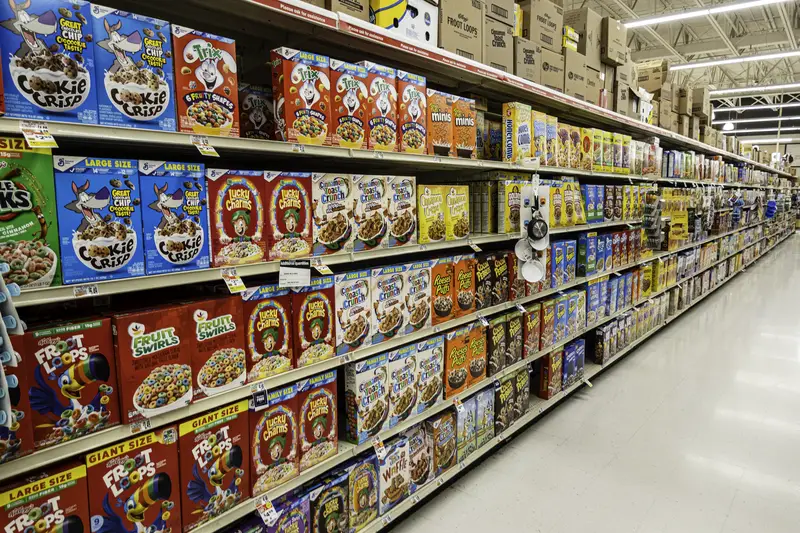
The bag looks like it came off a farm stand. Kraft paper, a photo of oats and almonds, the word “protein” near the top, maybe “organic” in a little green circle. It costs more than a box of Cheerios and it goes into the cart with a clear conscience. Then you flip it over. A 63-gram serving of Nature Valley Cranberry Almond Protein Granola carries 19 grams of sugar and 280 calories. A Snickers bar is 250 calories. Granola is the thing to stop eating for breakfast, and the rest of the cereal aisle is not far behind.
Granola, The Most Expensive Candy In The Cereal Aisle
Nature Valley is not an outlier. Wegmans Organic Vanilla & Almonds Granola runs 17 grams of sugar and 280 calories in a 67-gram serving. Put that next to a Milky Way bar, which has 31 grams of sugar and 240 calories in 52.2 grams, and the granola is not the wildly different food the packaging is selling.
The serving size is where the trick lives. Granola is dense, heavy, and clustered, so 63 grams is a modest scoop, not the bowl anyone actually pours. Dietitians keep naming granola as the most misleading breakfast on the shelf for exactly that reason: it is sold as restraint and eaten as cereal.
The 2025-2030 Dietary Guidelines for Americans dropped the added sugar cap from 10% of daily calories to under 6%. On a 2,000-calorie day, that works out to about 30 grams, roughly seven teaspoons. One scoop of the good granola takes most of it before 8 a.m.
Yoplait Original Strawberry And The Rest Of The Flavored Yogurt Shelf
A 150-gram cup of Yoplait Original Strawberry has 20 grams of sugar and 120 calories. A 12-ounce Coca-Cola has 39 grams. Chobani Vanilla Greek Yogurt is better at 15 grams of sugar in a 170-gram cup, but nobody is eating it because it is a moderate choice; they are eating it because the tub says Greek and they assume that settles it.
Low-fat and organic versions are not the escape hatch. Take the fat out of yogurt and something has to carry the flavor, and it is usually sugar. The label language does the rest of the work, which is the whole business model of the flavored yogurt case.
Buy the plain tub instead. Stir in real berries and a shake of cinnamon and you have paid less per ounce for a breakfast that tastes like food rather than a strawberry candle.
Bottled Smoothies From The Cooler Case
The bottle shows a kale leaf and three whole apples. What is inside is often very little actual fruit or vegetable, plenty of sugar, and in some cases high fructose corn syrup. You are paying six or seven dollars for juice with a good marketing team.
Blending itself is not the villain, but it does not leave fruit intact either. The Harvard T.H. Chan School of Public Health has explained that fiber gets physically broken down when it is blended, which changes how the drink behaves compared with eating the fruit.
Made at home, a smoothie is a decent deal, because you control what goes in. Spinach, oats, flaxseed, or plain yogurt turn it into something that eats like a meal instead of a large drink you finish in four minutes.
Doughnuts And Freezer-Aisle Waffles
A doughnut will run you 250 to 550 calories with 15 to 30 grams of sugar apiece. At least a doughnut is honest about what it is. Chicago-based registered dietitian Janet Helm treats them as a weekend treat rather than the base of a weekday breakfast, which is the sane position.
Frozen waffles, pancakes, and french toast sticks are the sneakier version of the same purchase. Most are simple carbs, and it is rare that they contain whole grains or much fiber at all. Read the panel before you assume otherwise, because the box front will not tell you.
The Bakery-Case Muffin
Big bakery muffins can hit 600 to 800 calories, more than most people would guess by looking at one. The dark, bran-flecked ones are the biggest con, because the color is doing the same job as the word “organic” on a granola bag.
Helm puts it plainly: “Muffins can look so virtuous, especially if they have ‘bran’ in the name or if they look dark. But many are just cake in disguise, without much whole grain or fiber.” If you want one, eat half and put it next to something with protein.
A Bagel With Cream Cheese
Most bagels are 300 to 500 calories worth of starch, about 65 grams of carbohydrates, before anything gets spread on them. Nutritionist Mitzi Dulan, RD, compares many bagels to four or more slices of white bread, then asks the obvious question: where is the protein?
Plain toast with butter is the same story in a smaller package. It is quick, it is cheap, and you will be looking for a second breakfast about 45 minutes later because there is nothing in it but bread and fat.
Half a whole-wheat bagel with peanut butter or mashed avocado is a completely different purchase. Same aisle, same three minutes, and it actually holds.
Flavored Non-Dairy Creamer And A Glass Of Orange Juice
Flavored non-dairy creamer is oil, sugar, and flavoring sold at cream prices. Many swap saturated fat for trans fat, and the tell on the label is “partially hydrogenated” oil, usually alongside sugar and artificial sweeteners. Unsweetened vanilla almond milk, low-fat milk, or a splash of vanilla extract does the same job for less.
The syrup-heavy coffee order belongs in the same category. Dulan points out that added syrups and sugar pile on calories without adding the protein or fiber that would actually carry you to lunch.
Juice gets treated as a meal by people who are not hungry in the morning, and Dulan is blunt about that one: “It’s all carbs, all sugar, and you’re not balancing it out with other nutrients.” Cold-pressed green juice is not exempt. Kale in the ingredient list does not make it breakfast. Eat the fruit and keep the fiber you paid for.
Breakfast Bars, Except The Few That Earn It
“Many bars are loaded with sugar and have little to no protein and fiber,” says nutritionist Rania Batayneh, MPH. That is most of the shelf: a candy bar with a wrapper that mentions grains, sold at a markup because it is filed under breakfast instead of checkout impulse.
A few clear the line. Batayneh points to KIND bars, many of which come in under 5 grams of sugar with at least 5 grams of protein. That is the standard worth applying to any bar you buy: protein, fiber, and fat on the panel, not just a photo of oats on the front.
Avocado Toast, Which Is Fixable
The avocado is rarely the problem. The bread usually is. Plenty of loaves marketed as whole grain are built on enriched flours with minimal fiber and hidden sugars, so the toast is doing less than the price suggests. Sourdough or sprouted grain is the better base.
Portion is the other half. A serving of avocado is about 50 grams, roughly a third of a medium one, and almost nobody stops there. Two slices with a whole avocado mashed across them is a lot of breakfast, whatever the cafe menu implies.
What Actually Deserves Your Grocery Money
Eggs. They are cheap, they cook in three minutes, and they are on the short list of protein sources the new federal guidance names outright, along with poultry, fish, red meat, beans, lentils, nuts, and soy. The guidance also suggests baking, broiling, roasting, stir-frying, or grilling instead of deep-frying.
Protein is the part of breakfast that got a real upgrade in the 2025-2030 guidelines. The old target of 0.8 grams per kilogram of body weight per day moved up to 1.2 to 1.6 grams, spread across every meal rather than dumped into dinner. Cereal alone does not get there.
Oats are still a bargain, but buy the rolled or steel-cut kind and cook them yourself. Pre-mixed flavored packets lean on instant oats, which are more processed and lower in fiber, and each packet brings its own sugar along for the ride.
If cereal is the hill you die on, use the panel as a filter. Look for at least 3 grams of fiber per serving, and the tighter version of that test is under 5 grams of sugar with at least 5 grams of fiber. Sugar hides under names like “evaporated cane juice” and “organic brown rice syrup,” so read the ingredient list, not the claims banner.
Chia pudding holds up as long as you respect the scoop. Two tablespoons of chia is 140 calories and 11 grams of fiber, and a lot of recipes call for far more than that, which turns a small bowl into a heavy one.
The loser here is granola, and it is the loser because it charges premium money to sell you a dessert with a farmhouse font. The winners are plain yogurt, whole fruit, real oats, and eggs, which cost less per serving than anything with “protein” printed on the bag. Skip the bag. Buy the eggs.
