

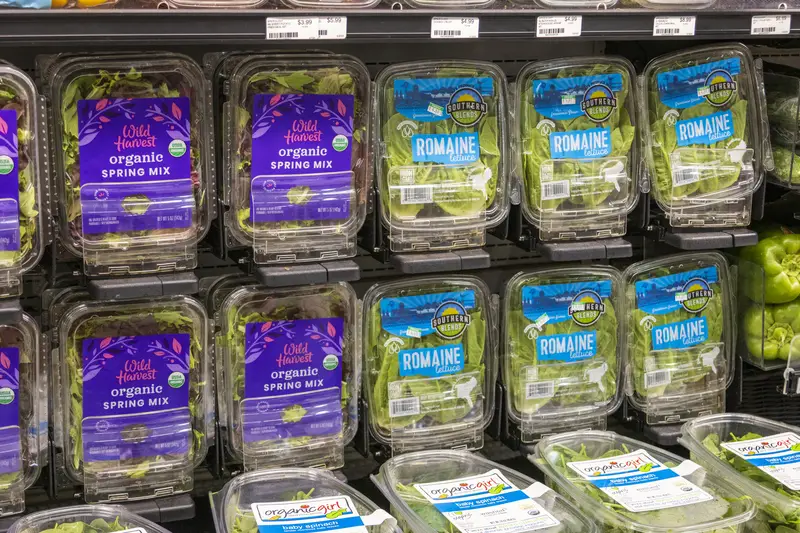
A bag of chopped romaine gives away nothing. Contaminated leaves look identical to clean ones, and the parasite behind the summer 2026 lettuce outbreak does not reliably change how a salad smells, tastes or looks. Neither does E. coli. So the only inspection that counts happens on the packaging: brand, package size, product code and the best if used by date, matched against the FDA’s active recall list before you open it. Anything that matches goes in a sealed bag in the trash or back to the store, not into the sink for a hopeful rinse.
That one habit is the difference between the worst lettuce purchase in the American grocery store and the one actually worth your money. Ranked from the bag you should have walked past to the buy that wins, here is how the options stack up.
8. Marketside Iceberg Salad And Shredded Lettuce (Worst)
Taylor Farms de Mexico voluntarily pulled all iceberg lettuce sourced from central Mexico off the U.S. market on July 17, 2026. The consumer end of that recall was Marketside-brand product sold at Walmart: Iceberg Salad in 12-ounce and 24-ounce bags, and Shredded Lettuce in 8-ounce and 16-ounce bags, with best if used by dates from 7/18/2026 to 8/3/2026. Those bags reached stores in 15 states, including Texas, Florida, Georgia, Tennessee, Louisiana, Missouri, Indiana and West Virginia.
Federal investigators have counted 11,458 laboratory-confirmed illnesses across 20 states, with at least 495 hospitalizations and two deaths, both in Michigan. Illness onsets ran from June 14, 2026 through August 15, 2026, which means most people were already sick before the recall existed. A recall cannot reach lettuce that has already been eaten, and this one mostly confirmed a shelf life that had run out rather than stopping anything. The FDA also announced on July 19 that its positive Cyclospora test on the product was a false positive, and left the recall in place anyway.
The best-by dates are long gone and the FDA says the product should no longer be in stores or restaurants, so the label check below will not catch this one. It still earns last place, because it is the clearest example of a bag that looked perfectly fine to everyone who bought it, and because the next recall will look exactly the same.
7. Bulk Food Service Shredded Lettuce And Romaine Blends
Behind the July recall sat 33 other types of recalled lettuce that never went near a home refrigerator, because they shipped to restaurants and catering operations. The full list covered shredded iceberg, iceberg salad, lettuce and romaine blends, and salad mixes with carrots and red cabbage, distributed to food service customers in at least 31 states by the FDA’s August count.
Read that carefully, because it is where shoppers get confused. Romaine appeared on the recall list only as a component of blends that also contained the iceberg under investigation. Investigators did not identify romaine or butter lettuce as suspect, including romaine distributed by the same company, and Taylor Farms said its other U.S. products were not affected. The lesson for buyers is less about romaine itself than about format: the more farms and the more cutting that go into one sack, the less any single label can tell you about what is inside.
6. Bagged Salad Kits And Chopped Blends, Any Brand
Bagged salad exists because of centralized processing, and centralized processing is exactly what turns a small field problem into a national one. Product from many farms is washed, cut, mixed and packaged together in a small number of very large facilities, so one bad batch spreads across a volume far bigger than the acreage it came from. That is why recall notices cover such wide date ranges.
Bill Marler, who has represented food poisoning victims since 1993, put the mechanics plainly in a May essay: “One head of E. coli-contaminated lettuce can be cut, processed, mixed with other lettuce, and then cross-contaminate many different packages of bagged salads.” He argues the modern romaine outbreak era exists because Americans wanted bagged salad in the first place.
On value alone, the kit is the weakest thing in the produce aisle. You are paying a premium per pound for shredding, a dressing packet and a sack of inert gas, and the dated bag is on a clock the moment it is sealed.
5. Bagged Romaine Hearts And Chopped Romaine
Romaine has its own track record. Between 2015 and 2021, E. coli O157-contaminated romaine was implicated in seven U.S. outbreaks, six of them multistate, producing 4,274 laboratory-confirmed illnesses, 766 hospitalizations and 11 deaths. The 2018 outbreak traced to the Yuma, Arizona growing area infected 210 people in 36 states, hospitalized 96 and killed five, by the FDA’s final count.
What made Yuma different was the explanation. Outbreak strains turned up in water samples along a 3.5-mile stretch of the Wellton irrigation canal, running next to romaine farms and next to a concentrated animal feeding operation with roughly 105,000 cattle. The 2019 Salinas Valley investigation found the same pattern in miniature, with the outbreak strain in a fecal-soil sample from a cattle grate on public land less than two miles upslope from a produce farm. Marler’s summary of his own caseload is blunt: “Romaine lettuce E. coli outbreaks have replaced ground beef as the staple of the Marler Clark practice.”
Then there is the romaine outbreak nobody was told about, in the autumn of 2024. It sickened 89 people in 15 states, hospitalized 36, caused kidney failure in seven and killed one. An internal FDA memo dated 11 February 2025 linked it to a single lettuce processor and ranch, and officials never publicly identified the grower, because the FDA said no product remained on the market. Colton George, an Indiana boy of 10 whose kidneys were damaged by a genetic match to that strain, is the plaintiff behind a lawsuit his parents filed on 17 April 2025 in federal court for the Southern District of Indiana against the lettuce grower, as KFF Health News reported. A label check only works when somebody tells you what to check for.
4. Anything Sold On A Triple-Washed Label
The most oversold three words in the cooler. FDA guidance notes that washing leafy greens under running water may reduce but does not eliminate pathogens, and for produce under an active recall the instruction is disposal, not washing. E. coli O157:H7 can cling to leaf surfaces and get in through stomata and damaged tissue, and contaminated irrigation water taken up by the roots can carry bacteria into the plant, which no rinse reaches.
Consumer Reports’ guidance on lettuce lands in the same place: whether the bag says triple-washed or you wash it yourself at home, bacteria can still be present, and the wrinkles and grooves of a leaf hold onto them. A soak in a vinegar-and-water solution for about 10 minutes followed by a rinse may knock levels down somewhat, but it does not clear them. The CDC has logged 78 foodborne disease outbreaks linked to leafy greens between 2014 and 2021. Buying the wash claim as a guarantee is the single most common mistake shoppers make with lettuce.
3. Restaurant And Drive-Thru Lettuce
The 2026 investigation cracked open because sick people in Indiana, Kentucky, Michigan, Ohio and West Virginia had one thing in common: they had eaten at Taco Bell. Michigan’s health department reviewed detailed food histories from 190 Taco Bell patients, and 90% reported eating iceberg lettuce. Supply records then converged on one grower, Taylor Farms de Mexico, and Taco Bell stopped using that lettuce as of July 17, 2026.
North Carolina health officials made the fair point that Cyclospora contamination generally starts where an ingredient is grown, not in the kitchen that serves it. Still, a counter salad is the one purchase where you cannot read a package size or a date code, which is why it sits this low. The only check available is asking whether the restaurant pulled recalled product, and that is worth asking while the investigation is open.
2. Romaine Grown On Your Own Counter
Indoor hydroponic greens skip most of the pathways that cause lettuce recalls. There is no agricultural irrigation water and no livestock operation upstream, no processing facility where batches from many farms meet, no open field exposed to runoff or wildlife, and no supply chain between harvest and bowl. Romaine, butterhead and arugula all grow this way. It is not sterile: research has shown salmonella and listeria will move readily onto the leaves if anything gets into the nutrient water, and clean hands still matter.
It is the shortest supply chain available to you, and it is not first, because it costs equipment and counter space and will never fill a bowl for a dinner party. As a supplement to the grocery run it is genuinely useful. As a replacement for it, unrealistic for most households.
1. A Whole Head Of Romaine You Break Down Yourself (Best)
Whole heads win on both counts that matter. Their inner leaves are less exposed to contamination sources and get handled far less than greens that have been cut, tumbled, mixed and bagged, which is the entire reason food safety researchers keep steering shoppers toward them. Strip the outer two or three leaves, rinse the rest under cold running water, and dry it. That is risk reduction, not a guarantee, and worth doing regardless.
The rest of the routine is unglamorous and free. Pick the head or package with the furthest-out date on the shelf, get it into the refrigerator promptly because bacteria multiply at room temperature, and keep it away from raw meat on the cutting board. Produce from a local farm or a farmers market may carry less risk than a nationally distributed bag, though any crop can pick up a problem from a tainted water source, so local is a better bet rather than a clean one.
You are also buying lettuce instead of lettuce plus labor, which is the closest thing to a bargain in the produce section. Federal officials are not telling anyone to stop eating iceberg or romaine, and because Cyclospora is very unlikely to pass directly from person to person, an outbreak like this one fades once the product is gone. Consumer Reports has pressed Congress to fund the research and traceability work that would let investigators name a contaminated food faster. Until that exists, the package is the only paperwork you get. Read it.
