

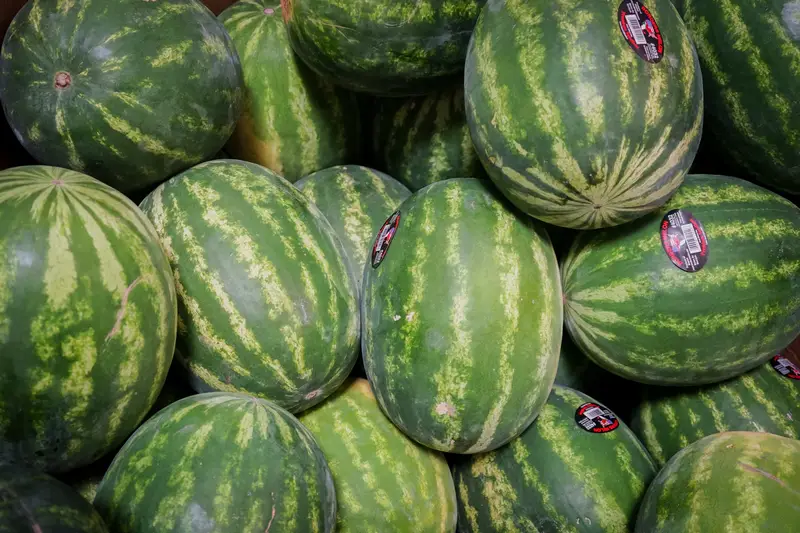
A watermelon spends its entire life lying in the dirt. Then it gets loaded onto a truck, stacked in a warehouse, parked in a cardboard bin by the sliding doors at the supermarket, and thumped, squeezed, and rolled over by every shopper who walks past it. By the time one lands on your kitchen counter, it has been handled dozens of times. Most people take it straight to the cutting board, because nobody eats the rind, so who cares what is on it? Your knife cares. The one step worth adding before you slice is the simplest thing in the world: rinse and scrub the outside under running water first.
The Knife Is The Problem, Not The Rind
Push a blade through an unwashed rind and you drag everything sitting on that surface straight into the red part you are about to eat. The rind is a shield right up until the second you break it, and then it becomes a delivery system.
The FDA’s advice is to wash produce under running water before you cut it, even when you will not eat the peel, and to scrub firm produce like melons with a clean produce brush. University of Georgia Extension gives American shoppers the same instruction, listing the outside of the melon alongside your hands and your cutting surfaces as things to wash before the knife comes out.
Watermelons grow directly on the ground, exposed to soil, irrigation water, insects, and sometimes animal waste. After harvest they move through warehouses, distribution centers, and store displays, picking up more along the way. And unlike chicken or ground beef, watermelon never sees heat. There is no cooking step to clean up after you. In 2018, pre-cut melon, watermelon included, was linked to a Salmonella outbreak that sickened 77 people in nine states.
Water And A Brush, That Is The Whole Method
No soap. No bleach. No twelve dollar produce spray in a pretty bottle. Hold the melon under cool running water and scrub it with a clean produce brush, then dry it with a paper towel before cutting. The friction does the work.
Scrub the whole surface, every side of it, then rinse it well.
Drying is not an optional flourish. A wet rind drips right back onto your cutting board, which undoes the rinse you just did. Wipe it down, then cut.
Your Cutting Board Matters As Much As The Melon
Washing the rind buys you nothing if the board underneath it held raw chicken an hour ago. If you are using one board for everything, wash it with soap and hot water first. Better, keep one board for raw meat and a separate one for fruit, and never let them trade jobs.
Use a sharp knife. A sharp blade slices cleanly, while a dull one crushes and tears, leaving rougher exposed surfaces behind. Watermelon is also heavy and slick, so put a damp cloth under the board to keep the whole operation from sliding across the counter while you are leaning into it.
Once the melon is open, keep the discarded rind away from the cut flesh. Do not stack cubes back onto the hull they came out of.
The Clock Starts The Second You Cut
Cut watermelon should be eaten right away or refrigerated within two hours. UGA Extension cuts that to one hour when the temperature is 90 degrees or higher, which covers roughly every cookout where watermelon shows up in the first place.
That tray sitting on the picnic table in the sun all afternoon blew past the limit hours ago.
Leftovers go in a sealed container in a fridge at 40 degrees or colder and get eaten within two to three days. Press plastic wrap directly against the cut surfaces or use an airtight container, since exposed flesh dries out and picks up every smell in your fridge.
Buying it already cubed at the store? Make sure it has been kept on ice or refrigerated, and eat it the same day. Pre-cut fruit sitting out at an unrefrigerated stand is the riskiest version of this fruit you can buy.
Pick A Melon Worth Washing
The single best signal is the field spot, the pale patch where the melon sat against the soil. On a ripe one it is creamy yellow or buttery yellow. White or pale green means it came off the vine too early, and no amount of counter time fixes that.
Next most trustworthy is the tendril, the curly pigtail where the fruit attached to the vine. Brown and dried out is the signal you want. Green and bendy means wait. Extension programs at Maryland, Illinois, Georgia, and Minnesota all list it, which is about as close to unanimous as garden advice gets.
Two variety quirks are worth knowing if you grow your own. In some varieties, the tendril can turn brown 7 to 10 days before the melon is ripe, so treat it as a heads up and let the field spot make the final call. And Black Diamond Yellow Belly lives up to its name: its ground spot turns yellow as it ripens.
The Thump Test Is Mostly Theater
Everybody knocks on the melon. Almost nobody can actually read it. A ripe one is supposed to give a dull, hollow sound while an unripe one rings high-pitched or metallic, and Illinois Extension says the field spot, tendril, dull skin and rind texture are much more reliable than thumping. Some ripe melons never give that dull thud at all.
The science explains why. In a study in the Journal of Food Science and Technology, researchers shook Crimson Sweet melons across a 0 to 1,000 Hz range and read the vibrations with a laser. Using the strength of those vibrations, a computer sorted ripe from unripe about 95 percent of the time. That took lab gear and software, not a knuckle, and Iowa State Extension says most people have trouble telling the sounds apart.
Thump away if it makes you feel better. Just use it as a tiebreaker between two melons that already passed the field spot check, not as your deciding vote.
Dull Skin, Heavy For Its Size, And The Thumbnail Trick
Shine is a red flag. UGA Extension puts it bluntly in its watermelon picking guidance: “Dull skin is a good sign. Shiny melons tend to be underripe.” The rind loses its waxy gloss as it matures.
Weight is the other easy one. Pick up two melons of the same size and buy the heavier one. That extra heft is water content, which is juice.
Then there is the thumbnail test, which barely anyone mentions. Press your thumbnail hard against the rind. Illinois Extension says a ripe melon’s rind “becomes resistant to penetration by the thumbnail and is rough to the touch.” Run your fingers over it and you can feel the difference.
Stripes tell on a couple of varieties too. On Crimson Sweet, the dark green bands start breaking up near the blossom end as it ripens. On Charleston Gray, ripeness can show up as ribbed indentations along the rind.
There Is No Ripening It On The Counter
Watermelon is non-climacteric, meaning it stops building sugar the moment the vine is cut. Once it is picked, it will never sweeten up in your fruit bowl the way a peach or an avocado does. University of Florida Extension states it flatly: “once a watermelon is removed from the vine, it will no longer be able to become sweeter.”
A hard avocado turns into guacamole in two days on the windowsill. A bland watermelon just sits there being bland. What you buy is what you eat, which is the entire reason the field spot and the tendril are worth more than thirty seconds of your time at the bin.
Commercial growers do not guess at all. They use hand-held refractometers, and when samples from the center of several melons read 10 percent sugar or higher, the field is considered ready to harvest.
When To Throw The Leftovers Out
Good cut watermelon is firm, deep red or pink, sweet-smelling, with clear juice. The failure signs are obvious once you know them.
Toss it if it smells sour, fermented, or vinegary. Toss it if the flesh has gone mushy or stringy or faded. Toss it if the juice is bubbling or fizzing, which means fermentation started without you. Toss it if there are dark or grey patches, and toss it over any visible mold at all, since mold usually runs deeper than the spot you can see.
Also skip any whole melon with cuts, soft spots, dark patches, or leaking at the store. The rind only protects the inside while it is intact.
The Verdict
Under a minute at the faucet with a brush is the cheapest upgrade in your kitchen, and it is a step plenty of people skip because the rind goes in the trash anyway. The FDA and UGA Extension both tell you to do it, and neither one asks you to buy anything.
Pick with the field spot, confirm with the tendril, use the thump only to break a tie, rinse and dry the outside, cut on a clean board with a sharp knife, and get the leftovers cold within two hours, or one hour when it is 90 degrees or hotter. The melon you bought in July deserves better than a quick swipe on your shirt.
