

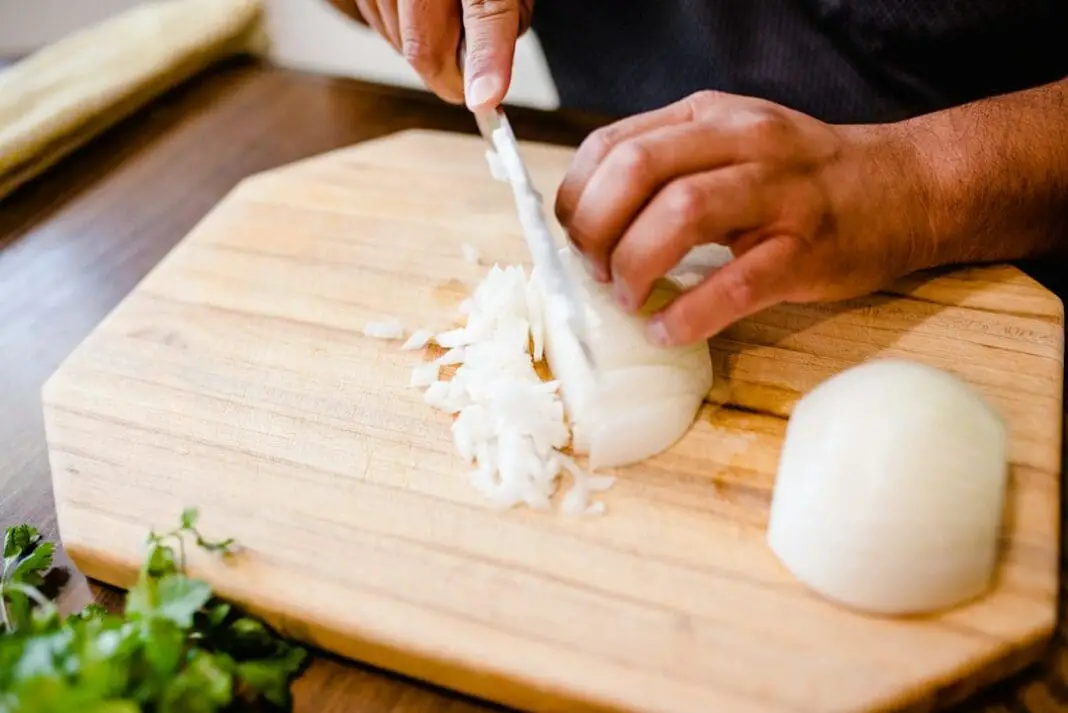
Half an onion goes into the fridge on Tuesday night under a tight sheet of plastic wrap. By Wednesday morning the butter smells like a deli counter. By Friday the cut face has gone dry, leathery and faintly gray. The wrap did not fail because you wrapped it sloppily. Thin plastic wrap is a poor barrier to the sulfur compounds a cut onion gives off, and they seep out through the sheet and around the edges. Give a wrapped half onion two or three days and the cut face starts to toughen. It is also the method in roughly every kitchen in America.
Plastic Wrap Is The Worst Option, And It Is Not Close
Wrap does one job well: it slows moisture loss, so a wrapped onion dries out slower than a naked one. That is the entire upside. The seal at the edges is almost never airtight, and the sheet itself leaks odor the whole time. A sliced onion in plastic wrap is good for one to two days maximum. Diced onion left loosely covered is not worth keeping past 24 hours. Aluminum foil has the same flaw and the added bonus of tearing when you unwrap it. If plastic wrap is all you have, use the onion that night or the next morning and stop pretending it is storage.
Your Butter Is The Real Victim
Cutting an onion ruptures its cell walls, which lets an enzyme called alliinase meet sulfur compounds that were stored separately inside the cells. The reaction produces thiosulfinates and other volatile sulfur compounds, the same chemistry that makes you cry at the cutting board. Those compounds keep off-gassing from the exposed surface for as long as the onion sits there, and porous foods soak them right up. Butter, soft cheeses and anything uncovered and dairy are the usual casualties,, and the smell can reach the food next to it within hours. Keeping cut onions on their own shelf, away from the open butter dish, costs nothing.
The Zip-Lock Bag Is A Step Up, Not A Fix
A zip-lock beats wrap because you can press most of the air out before you seal it, which slows the browning on the cut face. Figure four to seven days depending on how much air you squeeze out and how well the zip grips. The catch is that a zip closure is not airtight. Squeeze a sealed bag next to your ear and you will hear it vent. Same gap, same smell, just slower. If the bag is your plan, double-bag it: wrap the onion, put it in one bag, squeeze the air out, then seal a second bag around the first.
A Hard Container With A Real Gasket Is The Answer
A standard snap-lid container counts as the sealed container the National Onion Association has in mind, and the rigid sides stop the onion from getting squashed under a milk jug. For smell, the lid is still the weak point, since ordinary snap lids are built to be moderately airtight rather than sealed shut, and sulfur escapes around the gasket as the container warms up each time the door opens. Glass with a locking lid outperforms flexible plastic for odor. A food-grade silicone seal pressing against the rim is the tightest option of all. Store the onion cut-side down and get it in the fridge right after cutting.
How Long You Actually Have Depends On The Knife Work
The National Onion Association gives any onion you cut or slice yourself seven to ten days in a sealed container in the fridge. Surface area decides where in that window you land. A half onion cut straight across has the least exposed flesh and holds its crunch longest. Diced onion gives up moisture fastest, so check it sooner, and a paper towel in the container to catch moisture helps. Cooked onions are a separate rule entirely, three to five days refrigerated, and they need to be in a sealed container within two hours of coming off the stove.
Do Not Park It In A Bowl Of Water
Somewhere along the line the trick of keeping cut potatoes in water got applied to onions. It does not work. Submerging cut onion in plain water speeds up texture breakdown and leaches out water-soluble nutrients like vitamin C, so you end up with a limp onion that tastes like less than it did. If you want onion sitting in liquid, make it an acidified brine of vinegar, salt and water and keep it refrigerated. That is a quick pickle, and it tastes like one. Plan the dish around it rather than expecting a neutral raw onion at the other end.
Two Hours On The Counter Is The Whole Allowance
The cutting board is not a holding area. Once an onion is cut it needs to go in the fridge, and the outer limit at room temperature is two hours. In a kitchen above 90 degrees, which describes plenty of American kitchens in August, that drops to one hour. The same logic applies to the pint of pre-chopped onion from the produce aisle: it rides home in a cold bag, goes straight into the fridge, and its use-by date beats any rule of thumb here. The fastest way to kill a cut onion is leaving it on the counter while you finish cooking, then sticking it away an hour after dinner. Dry it with a paper towel before sealing it up, because standing water on the cut face is what turns the surface slimy.
The Old Chain Email About Leftover Onions Was Nonsense
You have probably seen the forwarded warning that a cut onion left overnight turns into poison because it pulls bacteria out of the air like a magnet. It is not true. PolitiFact ran the claim down in August 2019 and rated it False. Joe Schwarcz, the chemist who runs McGill University’s Office for Science and Society, took apart the same myth in 2017, pointing out that bacteria do not spontaneously generate. The cut surface of an onion dries out fast, and the acid the onion itself produces when you slice it actively works against bacteria. What matters is the board and your hands, so wash both and do not chop an onion where you just broke down chicken.
Whole Onions Want The Exact Opposite
Everything above reverses the second the skin is intact. The National Onion Association says to keep dry bulb onions in a cool, dry, well-ventilated place, and a pantry shelf or an unheated basement fits the bill. Moisture is the enemy: onions soak it up through the papery skin and go soft, which is why the fridge is the wrong home for them. Skip the plastic bag, since the onion association says the lack of air movement shortens their life, and use a mesh bag or an open basket. Keep them away from potatoes, which release moisture and gases that make both spoil faster.
Vidalias And Peeled Onions Break The Pantry Rule
Sweet onions are the exception. Vidalia, Walla Walla and Maui types carry more water and sugar in thinner skins, which makes them bruise easily and gives them a much shorter life than storage onions. Wrap each one in a paper towel and keep it in the crisper drawer with the vents closed, and the Vidalia Onion Committee says they can last up to three months. A whole onion you have peeled but not cut belongs in the fridge too, at 40 degrees or below. Scallions and green onions were never pantry food to begin with; treat them like fresh herbs and keep them cold.
Freeze It If The Plan Is Soup
Chopped onion keeps for months in the freezer, no blanching needed, which beats any container on the market. Freezing ruptures the cell walls, so what thaws out is soft and limp and has no business in a salad or a fresh salsa. For chili, stew, stir-fry, casseroles, stock and pan sauces it is indistinguishable. Spread the pieces in a single layer on a parchment-lined sheet pan, freeze them solid, then pour them into a freezer bag so you can scoop out a handful instead of chiseling at a brick.
When To Quit On It
Three signals end the argument: a slimy film on the cut surface, fuzzy white, blue or green mold, and a sour or fermented smell that is clearly different from normal onion sharpness. Mushy, wet layers or brown and black discoloration running through the interior mean the same thing. Light browning on the very outer edge of a cut face is just oxidation, and you can shave it off. The verdict is simple enough to act on tonight: retire the plastic wrap, buy one glass container with a locking lid, store the half cut-side down, and use it inside a week. An onion costs a dollar. The butter it ruins costs more.
