

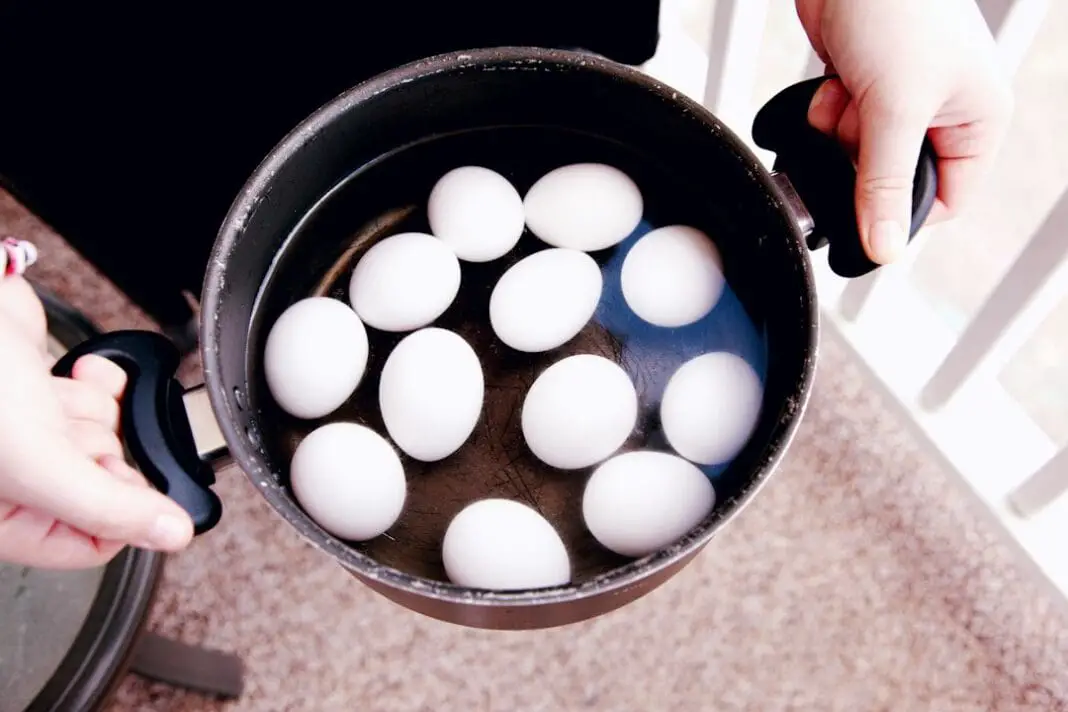
You usually hear it before you see it. A soft tick against the bottom of the pot, then a ribbon of white curling up through the water like smoke. One egg out of six has split, and ten minutes later it comes out waterlogged and half hollow, peeling like wet drywall. The egg was fine. The starting temperature was not. Cold eggs go into hot water and the shell takes the hit, which is why the single most useful thing you can do is pull the carton out of the fridge when you turn the burner on, not when the water is already rolling.
What a cold shell is actually doing in hot water
An eggshell is calcium carbonate, and it is not solid. It is riddled with something like 7,000 to 17,000 microscopic pores, with two membranes underneath and a pocket of air sitting at the wide, blunt end.
Heat that air fast and it expands faster than the shell can give. The weakest point splits. That is the crack, and it usually happens in the first couple of seconds, long before the white has set enough to seal anything.
Dropping refrigerated eggs into boiling or simmering water sets off a reaction violent enough to break shells, and what you get back is a waterlogged egg instead of one that stayed protected inside its shell the whole time. The temperature gap does something else too: it encourages the white to grab onto the inside of the shell, so even the eggs that survive intact come out harder to peel and smaller by the time you have picked all the fragments off.
Take them out when you turn on the burner
Twenty to thirty minutes on the counter is enough to close most of the gap. Nobody plans that far ahead on a Tuesday, which is why the version that actually gets used is simpler: set the eggs on the counter at the same moment you put the pot of water on the stove. Water takes several minutes to come up to temperature, and the eggs are warming the whole time.
In a hurry, put the eggs in a bowl and cover them with tepid water for five to ten minutes. Warm water gets there faster, in roughly ten to fifteen minutes. If your kitchen is running warm, above 70 degrees, skip the long counter rest entirely and just rinse the eggs under warm tap water, around 100 degrees, for about 30 seconds. That raises the surface temperature without leaving anything sitting out.
There is an outer limit on all of this. Standard egg handling guidance caps raw shell eggs at two hours out of refrigeration, and less than that in a hot room. A half hour rest is nowhere near it. Forgetting the carton on the counter through an afternoon of errands is a different story.
A rolling boil is doing half the damage
Temperature shock cracks shells. Physical impact cracks them too, and a hard rolling boil delivers plenty of it. Eggs bounce off the bottom of the pot and off each other while the water churns, and every one of those knocks is looking for a weak spot.
A gentle simmer runs about 180 to 190 degrees. Visually, that is small steady bubbles rising in a column, not a churning surface. Lower each egg in with a spoon rather than tipping them in from the carton, keep at least an inch of water above them, and do not crowd the pot or stir once they are in.
A reasonable target for technique is a crack rate at or under 5 percent, measured across five or more batches. If you are splitting one egg in every six, something in the routine is off, and it is almost always the shock, the churn, or both.
Starting in cold water is the peeling problem
The instinct, once you know cold eggs crack, is to put them in cold water and bring the whole thing up together. That solves the crack and creates a worse problem.
Culinary scientist J. Kenji López-Alt tested this at a scale nobody else has bothered with, running thousands of eggs past dozens of volunteers in a double-blind setup. The finding was blunt: the temperature at which the egg starts cooking is the single biggest factor in whether it peels cleanly, and a cold water start is the worst thing you can do to a batch you intend to peel.
Which puts the two rules together. Hot start, warm eggs. The hot start is what gives you a clean peel, and warming the eggs first is what lets them survive the hot start.
Why the white welds itself to the shell
Peeling fails for a chemical reason, not a luck reason. The proteins in the white unfold as they heat, and if they heat slowly they have time to reach out and bond with the keratin proteins in the inner membrane. That bond does not come undone. When you pull the shell away, it takes cooked white with it, and you end up with a cratered egg and a pile of shrapnel in the sink.
Egg age changes how strong that bond gets. A freshly laid egg has a white saturated with carbon dioxide, sitting around a pH of 7.6, and those proteins bind hard. As the egg sits in the fridge, carbon dioxide leaks out through the pores and the pH climbs to something like 8.7 to 9.2. The more alkaline white is far less inclined to grab the membrane. The egg also loses a little moisture, so the air cell at the base grows and gives you something to start peeling from.
So farm-fresh eggs are the ones that fight you. Save those for frying and poaching. For boiling, reach for the older carton, ideally something around five to nine days past the pack date, which is aged enough to peel easily without being ancient.
The vinegar and baking soda thing
Every egg guide on the internet eventually tells you to throw something in the water. Half a teaspoon of white vinegar per quart. A teaspoon of kosher salt. A spoonful of baking soda, because alkaline eggs peel better.
The baking soda logic falls apart immediately, because it cannot get through a calcium carbonate shell to change the pH of anything inside. Vinegar will dissolve a shell if you leave a raw egg sitting in a jar of it for three days. Ten minutes in a diluted pot of boiling water is not that. Salt has not shown a meaningful effect on cracking in controlled testing either.
López-Alt put it plainly in The Food Lab: “Though some people claim that adding salt, vinegar, or baking soda to the water when you boil an egg can affect its final texture, in my testing, I found that the only factors that matter when boiling an egg in its shell are time and temperature.”
The pin trick stays in the drawer
There is a real technique behind piercing the blunt end of the shell with a pin. It vents the air cell so the pressure escapes gradually instead of blowing out a seam, and some commercial egg processing operations do it.
In a home kitchen it is not worth the trouble. USDA food safety guidance does not recommend puncturing shells, the pin has to be clean, and the hole you just made lets water seep into the egg while it cooks. You are trading one waterlogged egg risk for another. Warming the eggs and easing off the boil solves the same problem without poking anything.
Also worth skipping: the viral clip of somebody cracking both ends and blowing the egg out of the shell. It works about as often as a coin flip, and only on eggs that were already cooked and chilled properly.
Timing, and the ice bath you keep skipping
Whites and yolks set at different temperatures, which is the whole reason boiled eggs are finicky. Egg whites start to thicken at 140 degrees and are fully firm at 180. Yolks start thickening later, at 150, and are firm by 158. Push past that for long enough and you get the rubbery white, the chalky yolk, and the gray-green ring, all of which are just overcooking with different names.
For a gentle simmer start, six minutes lands soft-boiled and ten to twelve minutes lands hard-boiled. Eggs that came up to room temperature first cook a touch faster, on the order of 30 seconds, so pull them a hair early the first time and adjust.
Then get them into ice water immediately, for at least five minutes. That stops the cooking cold and makes the shells come off far more willingly. One more thing: never try to boil an egg in the shell in the microwave, water or no water, because steam builds inside the yolk with nowhere to go. Keep the finished eggs in the fridge.
What actually works
Older grocery store eggs, out of the fridge the moment the pot goes on the stove. Water at a lazy simmer around 180 to 190 degrees, eggs lowered in with a spoon, an inch of water over the top, no crowding. Six minutes soft, ten to twelve hard, then straight into ice water for five.
Nothing goes in the water except the eggs. The vinegar, the salt and the baking soda are habits people inherited, and none of them beat simply not shocking a cold egg. Two variables carry the entire result, and both of them are free to fix.
