

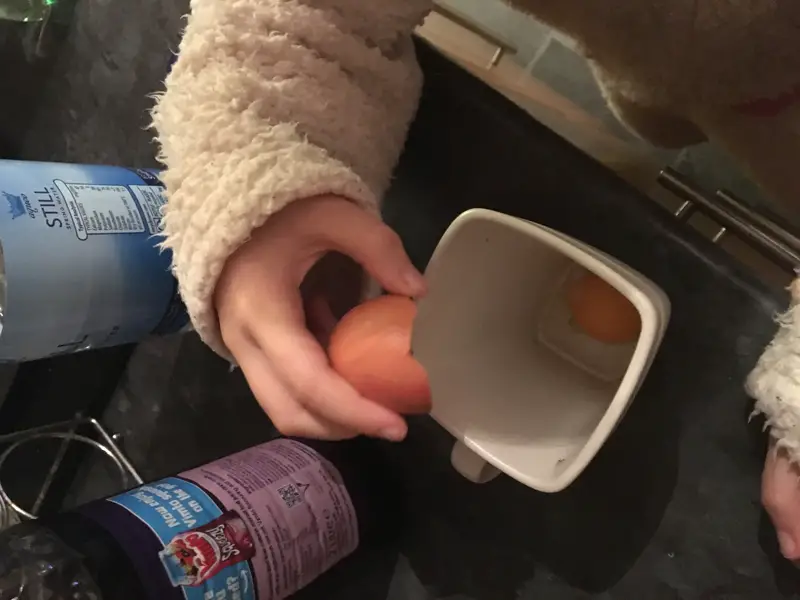
Your mom did it. Her mom did it. The rim of the mixing bowl is right there, already under your hand, and tapping an egg against it feels like the neat, grown-up way to do the job. It is also why you spend half your baking time chasing a white chip around the batter with a fork while it slides away like it’s greased. A sharp bowl lip does not break a shell cleanly. A flat countertop does, and the reason comes down to a part of the egg almost nobody thinks about.
There’s A Thin Skin Under The Shell Doing All The Work
Just beneath the surface of the shell is a thin membrane. When you crack an egg on a flat surface, that membrane stays in one piece and acts like a strip of tape across the break, holding the small fragments to the shell as you pull it open over the bowl. Crack on a rim and the edge tears that skin apart, so the shards have less to cling to and are more likely to drop into the bowl. Taste of Home’s Test Kitchen cooks treat the countertop method as their default.
A Rounded Edge Makes A Dozen Little Cracks, Not One Good One
Gently tapping an egg over and over against a curved edge creates a spiderweb of tiny fractures across the shell. Then your thumbs come in and push every one of those fractures inward. That’s a big reason shell ends up in your scrambled eggs, and it has nothing to do with being clumsy. There’s also the obvious geometry problem: you are breaking the egg directly above the bowl, so anything that chips off lands in the food. Break it on the counter and the debris stays on the counter, where it belongs.
Hit The Equator, And Hit It Once
Stand the egg up in your mind. The middle, the spot where it would wear a belt, is your target. The ends are the strongest part of the shell, so aim for the side. Grip the egg firmly but without strangling it, and rap it against the counter so the side lands squarely, one sharp strike. Several timid taps shatter the shell into a mess of small pieces; one confident smack gives you your best shot at a single jagged split. Smashing it too hard is its own disaster, because a crushed shell guarantees chips in the bowl. There is a sweet spot between the two, and a little practice gets you there.
Once it’s cracked, move the egg over the bowl and press your thumbs inward to pry the halves apart. Yes, you may leave a small puddle of white on the counter. Raw egg can carry Salmonella, so wipe the counter down with hot soapy water when you’re done.
The Yolk Is The Other Casualty Nobody Counts
Shell chips are annoying. A busted yolk ruins the plan. The force of a rim strike is uneven by nature, concentrated on one narrow line, and it can rupture the yolk before the egg ever leaves the shell. If you wanted a sunny-side-up with a runny center, or a poached egg sitting on toast, you’ve already lost. Separating whites from yolks gets harder too, because a pierced yolk bleeds into the whites and even a trace of yolk can stop whites from whipping. America’s Test Kitchen found the smaller shards from a bowl edge can puncture the yolk.
Cracking On The Pan Rim Is The Worse Version Of The Same Habit
Everything wrong with a bowl rim applies double to a hot skillet. The jagged break drives shell into the white, the shards fall right where they can’t be retrieved, and now there’s melted butter or oil sitting in the pan waiting for something to disturb it. Crack an egg at the edge of a pan that’s already over the burner and you can catch splashback on your fingers or down your shirt. Break the egg on a flat surface, open it over a small bowl, look at it, then slide it into the pan. It costs you about four seconds.
Stop Passing The Yolk Between Shell Halves
The classic separating move, tipping the yolk back and forth between the two broken halves while the white drips out, is working against you. Those shell edges are sharp enough to slice the yolk open, and rolling the yolk over the shell can carry germs from the shell into the egg. Crack the whole egg into a bowl instead and use your hand as a strainer. Cup the yolk in your palm and let the white run out between your fingers. It feels strange the first time and it works every time after that. Wash your hands with soap and warm water before you start and again when you’re done, or use a cheap egg separator if you would rather keep your hands out of it.
Crack Into A Small Bowl Before The Big One
This is the single habit that separates people who never have a problem from people who are always picking at batter. Break each egg into a small cup or bowl first, check it, then pour it into the mixing bowl. You catch fragments while they’re still easy to see, instead of hunting for a translucent chip at the bottom of a quart of cake batter. You also catch a bad egg before it joins the butter, sugar and flour you already creamed. One cheap ramekin saves the whole cake.
Shell Sticks To Shell, So Fish With Shell
When a piece does get in, put your finger down. Your fingertip is smooth and wet, and it pushes the fragment away over and over while you chase it around the bowl. A spoon is worse. Use one of the empty half shells instead. The jagged edge traps the piece rather than repelling it, and the two scraps of shell seem to find each other on contact. Scoop, lift, done. If the eggs are going into something that will not be cooked through, use a clean spoon instead, since the outside of the shell can carry bacteria.
And for the record, none of this changes with brown eggs versus white. Shell color does not change nutrition or flavor. It comes down to the breed of hen: in commercial flocks, white-feathered hens with white earlobes lay white eggs and red-feathered hens with red earlobes lay brown ones.
The Two-Egg Trick, And The Show-Off Move That Proves The Point
There’s a middle-tier technique worth knowing: hold an egg in each hand and tap them together at the equator. Only one of them breaks. Open that one over the bowl, pick up a fresh egg, repeat. When you’re down to the last one, crack it on the counter. It’s a party trick that actually saves time, and kids love it.
The advanced move is the one-handed crack, with your thumb and index finger on one side of the equator and your middle and ring fingers on the other, pulling the shell apart in one motion. It looks great. It is also the messiest of the three and the most likely to drop shell in your bowl, which is the whole argument against rim-cracking showing up again in a different outfit.
Line Cooks Don’t Use The Rim, And Not Because Of Technique Snobbery
Plenty of restaurant cooks crack on the counter for speed, not purity. Once you have the rhythm you can work through a flat of eggs fast on a flat surface, with less to clean up at the end. Lots of chefs and cooking instructors favor the countertop, though not all of them, and plenty of home cooks still reach for the edge of a bowl or pan.
Don’t Wreck Them After All That
A clean crack is wasted on overcooked eggs. For a big batch of scrambled, whisk the eggs smooth in a large bowl, melt a generous knob of butter in a big nonstick pan over medium heat, and pour them in. Leave them alone for about a minute so the bottom just sets. Then drag a heatproof spatula from one side of the pan to the other, folding the eggs into large curds, and keep folding for roughly another minute until they’re almost set. Fold through a little cream at the end and get them off the heat early, because the eggs keep cooking on the plate. Cooking for anyone pregnant, very young, older or with a weakened immune system? Cook them until firm.
The verdict is not close. The bowl rim is a habit inherited from people who never questioned it, and it costs you shell fragments, broken yolks, white running down the outside of your bowl and egg on your fingers. A flat counter, one firm strike at the equator, thumbs over a small bowl. That’s the whole method, and it gets easier every time you do it.
