

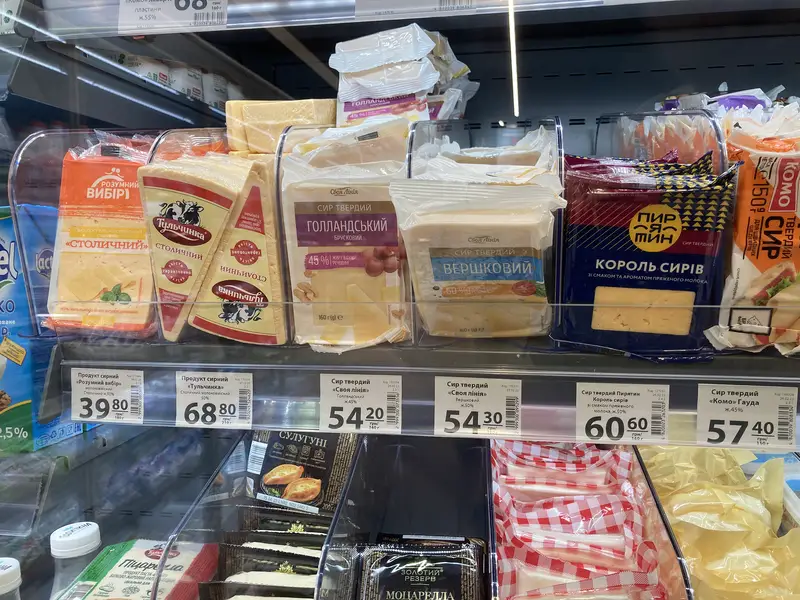
The locked plexiglass cases in American stores tell you exactly what retailers are scared of. Razor cartridges. Batteries. Detergent pods. Teeth whitening strips behind a buzzer that summons a teenager with a key. The dairy case gets none of that. A block of aged white cheddar sits in an open cooler, priced like a decent bottle of bourbon, wrapped in film that peels off in about two seconds, roughly twenty feet from an unwatched exit. Which is a fair part of the reason cheese, not steak, not shrimp, not infant formula, is the food that leaves American grocery stores unpaid for more than anything else. A 2011 report in Time named it the most stolen food on Earth, with nearly 4 percent of the world’s cheese inventory disappearing every year. That report has never been updated. Nothing has knocked cheese off the top spot either.
Four Percent Sounds Small Until You Weigh It
The United States produces roughly 12.7 billion pounds of cheese a year. If the global theft rate holds true here, that is 508 million pounds walking out the door annually, or about the weight of 127,000 average cars. Put another way, one in every 25 blocks made never gets scanned.
Americans eat about 40 pounds of cheese per person per year, and prices have gone the direction every other grocery price has gone. A wedge of real Parmigiano Reggiano or a good farmhouse cheddar now costs enough that the math on pocketing it starts to look different to a certain kind of shopper. Cheese used to be a commodity nobody bothered guarding. It is now closer to a small luxury sitting in the open.
Criminologists Have An Acronym For This
People who study retail theft use the word CRAVED to describe the products that vanish: concealable, removable, available, valuable, enjoyable and disposable. Cheese scores on all six. It fits under a jacket. It is stacked in an unstaffed corner of the store. It is worth real money. And the evidence gets destroyed by eating it. Alcohol checks most of the same boxes and gets locked up, tagged and watched. Cheese historically got nothing.
Other grocery categories take a beating too. Meat theft climbed 28 percent in 2023, with ribeyes, filets and lobster tails moving fast because they flip easily. Infant formula loses about 3.1 percent of inventory. And for perspective on how bad these numbers can get, in the early 2000s the Gillette Mach3 was reported as the single most stolen retail item in the U.S. and Europe, with theft rates hitting five percent. Cheese is in that company, sitting in an unlocked fridge.
Most Of It Is Not Going Home For Dinner
Cheese gets stolen in bulk for resale to other markets and to restaurants. That is the business model, and it is why the quantities get absurd. In 2017, Italian police ran an operation they called Wine and Cheese and picked up 10 people identified as the masterminds behind the theft of 168 wheels of Parmesan, worth $110,000.
Food crime as a whole, counting theft along with smuggling and counterfeiting, is estimated to cost the food industry $30 to $50 billion each year. Much of the stolen product is believed to move through black markets, with Russia named as one destination after it was cut off from much of the global food supply. Cheeses that are banned or hard to get somewhere legally are worth more to somebody selling them there illegally. This is what organized retail crime looks like when the product is refrigerated.
Parmesan Is Literally Bank Collateral
Parmigiano Reggiano is valuable enough that hundreds of millions of dollars worth of it sits in bank vaults, and some Italian banks will accept wheels as valid collateral on a loan. One estimate puts the amount stolen in Italy at more than $3 million every year.
The largest score on record came in 2015, when Italian police arrested an armed gang accused of stealing more than 2,000 wheels worth $875,000. Elsewhere in Europe the list reads like a bad caper script: 100 wheels of Comte in France at about $1,000 apiece, 22 tons of cheddar in England, $22,000 worth taken in a single planned job in the Netherlands in 2022, and 700 blocks of Saint-Nectaire lifted by French thieves in 2018, worth around $11,000. In December 2023, £50,000 of cheese was taken off a trailer parked at a U.K. service station.
The American Versions Are Weirder
Wisconsin, the state that makes more cheese than any other, has been hit the hardest. In 2016, thieves took a truck holding 20,000 pounds of cheese valued at $46,000. In 2013, a thief there drove off with a truck loaded with 21 tons of Muenster.
The inside job is the efficient route. In October 2019, police caught two men accused of taking $50,000 worth of cheese from Leprino Foods between 2017 and 2019. One of them reportedly worked at the California plant, which happens to be the world’s largest mozzarella manufacturer. Investigators were able to identify the recovered product by the serial numbers stamped onto the blocks.
Then there is the low-tech method. In 2011, two women walked into an Oregon Whole Foods and asked the counter for a box full of cheese. One headed toward the register. The other walked out the front door with $300 of Gouda and $270 of blue cheese. In 2019, a thief in Ontario posing as a delivery man drove away from Saputo Dairy Products with $137,000 worth, or $187,000 Canadian.
But The Typical Cheese Thief Is Just A Shopper
The heists get the headlines. The volume comes from ordinary shoplifting at the supermarket, thousands of small takes a day. Food and nonalcoholic drinks are the items Americans most commonly admit to stealing, cited by 30 percent of those who say they have shoplifted, ahead of clothing at 25 percent and personal hygiene products at 20 percent. Grocery stores are the most common location, named by 39 percent.
Three in 10 Americans now say they have shoplifted at least once, up from 23 percent in 2024, according to a LendingTree survey. Among people who did it in the past year, 90 percent said inflation and the broader economy played a part. “These findings are concerning because they suggest many people aren’t shoplifting for thrills or resale, but because they feel squeezed by basic affordability challenges,” says Matt Schulz, LendingTree chief consumer finance analyst.
More than half of them, 52 percent, say they have never been caught. Walmart was named most often as one of the easiest stores to steal from, by 47 percent, followed by Family Dollar at 21 percent, Amazon Fresh at 14 percent and Kroger at 11 percent. In the U.K., Sainsbury’s banned one customer for life after repeated thefts of meat and cheese adding up to £2,500.
Stores Have Started Watching The Dairy Aisle
U.K. supermarkets began putting security tags on cheese in 2022, many of them radio frequency alarm tags of the sort you find on jeans. Cheesemakers have gone further, embedding tiny chips in the rinds of wheels so the cheese can be tracked and checked for authenticity later.
American retailers are leaning on the same tools they use everywhere else. Roughly 76 percent use electronic article surveillance, ink tags, spider wraps or similar deterrents in at least some stores, and 52 percent use them in every location. About 65 percent have pulled specific products off the sales floor entirely in at least some stores. Refrigeration makes that harder with cheese, which is a large part of why it stayed unguarded for so long.
The odds still favor the thief. Stores catch shoplifters about 2.0 percent of the time, and the average shoplifter is arrested once for every 49 incidents.
Everybody Pays For The Missing Cheese
U.S. stores lost $47.8 billion to external retail theft in 2025, though the number of incidents fell 10 percent that year. The average shoplifting incident cost retailers $461.86 back in 2020. Small businesses take it worst per dollar of sales, losing an average of $1,686 a month, and 64 percent of them have raised prices in response.
So the answer to the question is cheese, and the reason is not romantic. It is expensive, it is portable, it keeps, it resells to restaurants and corner markets for cash, and for decades nobody bothered to guard it. Shoppers who think a store’s losses are somebody else’s problem should notice how many of those losses come back as higher shelf prices and a locked case where the good cheddar used to be. The dairy aisle is the last easy aisle in the store, and that will not last.
