

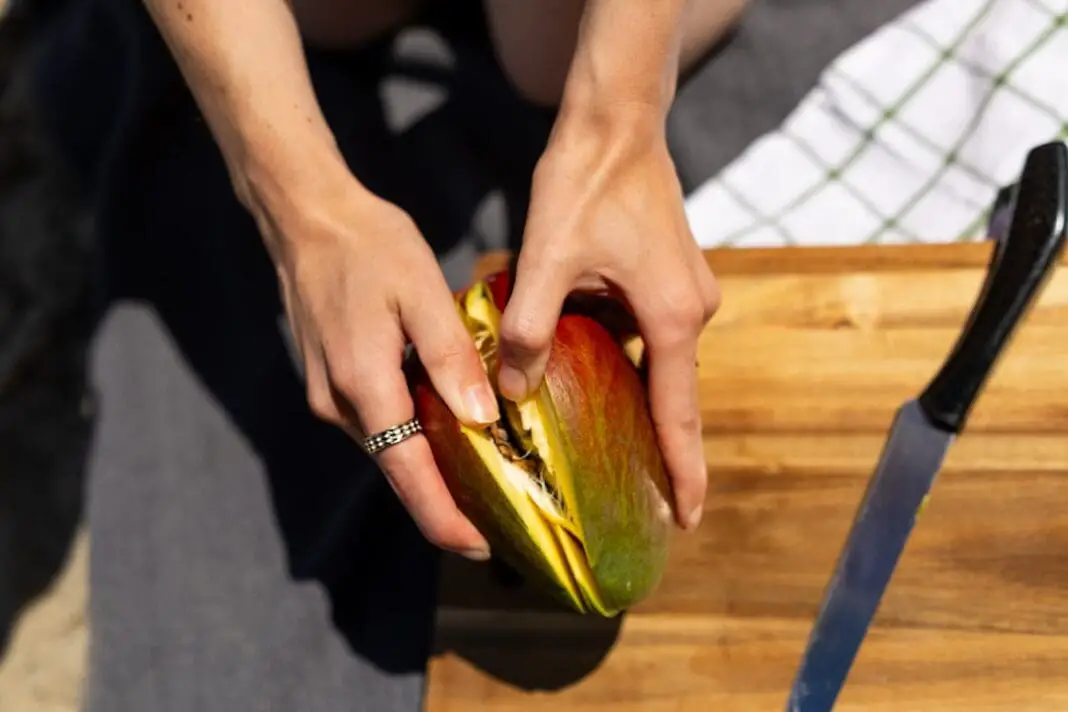
A mango costs a couple of bucks, takes five minutes to cut, and gets treated in most American kitchens as the responsible choice. The candy bar at the register is the thing you talk yourself out of. So it stings a little to learn which one is carrying more sugar. A single medium mango holds around 46 grams of sugar. A regular 1.55-ounce Hershey’s bar has 25.
That is not a typo, and it is not close.
Mango Beats Hershey’s And Snickers On The Same Scorecard
The 46 grams in one mango works out to about 11 teaspoons. A regular-sized Snickers bar has 28 grams, which means the fruit still wins by a wide margin against the candy most people consider the heavy hitter.
The Cleveland Clinic puts a different price tag on the same mango: 50 pieces of candy corn. Nobody eats 50 pieces of candy corn without feeling something about it. People eat a whole mango standing over the sink and call it a snack.
Before anyone swaps their fruit bowl for the vending machine, the comparison stops being useful right about there. A mango is 83% water. It brings fiber, vitamins and antioxidants along with the sugar. A chocolate bar is mostly sugar, fat and carbs, which is fine as a chocolate bar and useless as a nutrition argument. The number is the number, but the two foods are not doing the same job.
The Mango Is Not Sweeter Than Other Fruit, It Is Just Bigger
Here is where the scary headline number falls apart a bit. Weigh fruit gram for gram instead of piece for piece, and mango drops out of first place entirely. Per 100 grams, mango carries 11.1 grams of sugar. Black grapes hit 17.3. Lychee comes in at 15.2. Banana is 12.2 and pineapple 11.4, both ahead of the mango everyone is worried about.
Mango only tops the charts because a mango is enormous. You are not eating 100 grams of it. You are eating a fruit the size of your fist, sometimes bigger, and the sugar adds up the same way it would if you ate four bananas back to back.
On the glycemic index, which ranks how fast a carb food raises blood sugar, mango scores 48. That lands in the low range. Pineapple sits at 82 and a yellow-skinned banana at 75, both high. The fruit with the worst sugar total on paper is not the one that hits fastest.
Two Dates Match A Milky Way Almost Exactly
Mango is the headline, but dates are the tidier comparison. A 1.84-ounce Milky Way bar contains 32 grams of sugar. Two individual Medjool dates contain the identical amount. Two. Not a cup, not a handful.
Dates also carry vitamin B6, magnesium, potassium and fiber that the Milky Way does not, which is why the snack aisle has quietly built an entire category on them. Lara Bars use dates instead of sugar across flavors like blueberry muffin, cashew cookie and cocoa coconut chew. Joolies date pops come in cinnamon bun and brownie and turn up at Target, Walmart and Thrive Market. Harken Sweets sells a chocolate-covered bar it calls The Gooey One, built on nougat and date caramel. Amazon stocks Realsy Almond Butter Stuffed Medjool Dates, made with three ingredients.
If you have been buying date-sweetened bars because they felt like the cautious pick, they are still a better package than a candy bar. They are not a low-sugar one.
Almost Everything In Your Fruit Bowl Has A Candy Equivalent
Once you start converting fruit into desserts, the whole counter looks different. One large apple has 25.1 grams of sugar, which is a Hershey’s milk chocolate bar. A medium pear has 17.4 grams, roughly a large cinnamon roll. A cup of cherries hits 19.7 grams, or a regular-sized Snickers.
It keeps going. A large orange runs 17.2 grams, about four twisted red licorice ropes. A cup of pineapple chunks is 16.3 grams, a slice of cherry pie. One banana is 15.4 grams, a glazed donut. A cup of grapes is 14.9 grams, a slice of angel food cake. A cup of diced watermelon comes in at 9.42 grams, roughly a medium chocolate chip cookie, and watermelon is low in carbohydrates on top of that.
Beth Czerwony, a registered dietitian at the Cleveland Clinic, is not interested in anyone panicking over this. “I don’t want anyone to fear the sugar in fruit because these are natural sugars,” she said. Her point is that the body handles it differently than the sugar in cookies and cakes. She also says most people are not eating enough fruit for it to be a concern in the first place, unless they have a condition that requires watching blood sugar.
Juice And Dried Fruit Are Where It Actually Piles Up
An 8-ounce glass of fruit juice averages about 30 grams of sugar, roughly what you get from a glass of cola. Commercial juicing strips out the skin and pulp, and with them the fiber that slows everything down. It also strips out the bulk that makes whole fruit filling. Drinking three or four oranges takes a minute. Eating three or four oranges is a project you will abandon halfway through.
Drying does something similar by removing water and leaving the sugar behind. Per 100 grams, fresh red grapes have a glycemic load of 8. Raisins jump to 51. Fresh apricots sit at 4, dried apricots at 21. Two tablespoons of raisins or dried cherries carry about 15 grams of carbohydrate, the same as a small piece of whole fruit, packed into a few bites you will finish without noticing.
Tamarind belongs in this conversation too, and it is fresh fruit. Half a cup holds 34 grams of sugar, more than a Snickers, because the pulp is naturally dry rather than juicy.
The Fruits At The Bottom Of The Scale
Berries are the easy answer if you want to eat fruit without doing arithmetic. A full cup of raspberries has just over 5 grams of sugar. Strawberries and blackberries land around 7 grams per cup. A kiwi runs about 6.7 grams. Half a grapefruit is around 10.6 grams, and a cup of diced watermelon stays under 10.
Avocado, technically a fruit, contains roughly 1 gram in the entire thing. Lemons and limes barely register at 1 to 2 grams each, though you are not sitting down with one.
Tropical fruit does not have to be the enemy either. A guava has 5 grams of sugar and tastes like strawberry crossed with pear. Papaya comes in at 6 grams, with a mild sweetness some people say reads like mango, and the seeds are edible. A medium wedge of cantaloupe is 5 grams. None of those will ever end up in a headline next to a Hershey’s bar.
What To Actually Do With The Mango On Your Counter
Cut it and stop. Seven slices of mango count as one cup of fruit, and the USDA recommends about 2 cups a day for adults, with the range running 1.5 to 2 cups for adult women and 2 to 2.5 for adult men. A whole mango eaten in one sitting is not a serving. It is closer to two.
Pairing helps more than portioning alone. Fat and protein slow the whole thing down, which is why mango works well on a board with cheese and cured meats, or in a black bean and avocado salad with quinoa, or blended into a smoothie with something substantial in it. Czerwony suggests low-fat Greek yogurt with any sugary fruit for the same reason. Apple with peanut butter, berries with yogurt, pineapple with cottage cheese and pear with cheddar all work on the same logic.
The verdict, plainly: the mango is not the villain here. It just happens to be the biggest, sweetest single object in the produce section, and a candy bar is a small, precisely portioned thing designed to be eaten in about 90 seconds. Compare them piece for piece and the fruit loses on paper every time.
If you genuinely want to cut back on sugar without giving up fruit, the mango is not where the money is. It is the glass of juice with breakfast, the second handful of raisins from the bag on the counter, and the dried mango in the trail mix, which is usually sweetened on top of being concentrated. Fix those three and you can eat the mango.
